Tuesday, 10 April 2012

The Infinite Space of the Present (Wordsworth vs. Pater)


The moment.  The present: an infinite space, that once sensed, the mind flees from itself and dissolves to become the body.  'But don't you get bored?' I was asked yesterday.  A sensible question when you tell someone that you're running eight hours a week.  I get bored thinking about it, but never while I'm doing it.  Boredom is a fine balance between mental awareness and disengagement - the awareness is necessary in order to sense one's disengagement - and for me that is one of the last things likely to happen when I'm out running.  A state where perception is charged like static waiting to be earthed, and disengagement means the disappearance of self.


Mihaly Csikszentmihalyi, an Hungarian psychologist, coined a name for this in-the-body experience in his study Flow: the Psychology of Optimal Experience.  'Flow' is when 'the ego falls away. Time flies. Every action, movement, and thought follows inevitably from the previous one, like playing jazz.'  The activity is borne along by an unseen force, each movement, thought, idea, follows the next; as inevitable as the course of a meandering river.  The three tributaries of  attention, motivation, and skill all meet in this moment, and like the combination of the three primary colours, they find in their meeting their annihilation and become white light. 
But there is more to this experience than being colloquially 'in the moment'.  It isn't just about levels of concentration, one of the other effects of this free-wheeling biological imperative - the moment when the body becomes the essence of itself, the real 'I am' - is a perceptual gift.  It is lent from somewhere and later returned to that unknown place.  Call it passion, perception, a quickening, it is something.  Walter Pater called it a 'multiplied consciousness' for him it was a 'strange, perpetual weaving and unweaving' of self.  Everything is in flux, not just our biological lives, but everything all the way through our day-to-day existence to our aesthetic impressions.  If we are to suck upon the marrow of life we must develop skills of "sharp and eager observation": for "every moment some form grows perfect in hand or face; some tone on the hills or the sea is choicer than the rest; some mood of passion or insight or intellectual excitement is irresistibly real and attractive for us, – for that moment only".  Pater's assessment of the ideal is 'to burn always with this hard, gem-like flame, to maintain this ecstasy, is success in life. 
 Wordsworth, too, understood the value of the moment, its meaning, its reach, its longevity.  His 'Lines Written a Few Miles above Tintern Abbey on Revisiting the Banks of the Wye During a Tour, July 13, 1798', from its title, the poem announces itself as a study of both memory and its necessity.

The picture of the mind revives again:
While here I stand, not only with the sense
Of present pleasure, but with pleasing thoughts
That in this moment there is life and food
For future years.  And so I dare to hope
Though changed, no doubt, from what I was, 
when first I came among these hills; when like a roe
I bounded o'er the mountains, by the sides
Of the deep rivers, and the lonely streams,
Wherever nature led; more like a man
Bounded o'er the mountains, by the sides
Wherever nature led; more like a man
Flying from something that he dreads, than one
Who sought the thing he loved. For nature then
(The coarser pleasures of my boyish days,
And their glad animal movements all gone by,)
To me was all in all.

Turner - Tintern Abbey
The present, for Wordsworth, the paean of this extraordinary poem, is almost lost in a vortex of his childhood, his ideas of nature as they were when he was a boy, the future, and what this 1798 version of the present will mean to him then.  The present that the poem attempts to recount has disappeared into the mind of the poet.  It is extinguished in a flurry of thought and philosophy.  The distance between subject and object in the poem is significant.  The Abbey, the land, the sky, the world, all appear at a crane-arm's length.  The primary sense is the visual without the awkward personal proximities of touch or taste or smell.  The landscape runs in his veins, but he does not run through this landscape, only in his own memory of it.  Pater called it an 'impassioned contemplation' and felt Wordsworth a 'powerful and original poet, hidden away, in part, under those weaker elements' of his work.  How could he love Wordsworth when he argues elsewhere that perception is 'not the fruit of experience, but experience itself is the end.' 
Pater wished us to pitch ourselves upon the world and the moment.  Invoking Novalis's dictum 'to philosophize is to throw off apathy, to become revived', Pater argued 'of this wisdom, the poetic passion, the desire of beauty, the love of art for art’s sake has most; for art comes to you professing frankly to give nothing but the highest quality to your moments as they pass, and simply for those moments’ sake.'  Where Wordsworth saw the eternal possibilities of memory in the moment, Pater senses only the moment's immediacy.  For both, experience and perception are mental faculties.  One's philosophy seems to kill it, the other is 'revived' by it.  
The moment.  The present: an infinite space, that once sensed, the mind flees from itself and dissolves to become the body.  Even Csikszentmihalyi sees 'flow' as a mental state, where the ego disappears.  But it is the wrong word for the runner's experience.  Being 'in the zone' isn't right either.  The contiguity of 'flow' fits, but not what happens to consciousness and perception.  Instead, it is where corporeality meets hyper-reality; where the physical meets the metaphysical.  
In her writings about her life with her husband, Helen Thomas discussed how, as a late-Victorian woman, she discovered her body.

I loved being without clothes, and moving about naked, and I took pride in my health and strength.  Edward and I read Richard Jefferies, and with delight I found the joy in one's body spoken of there as if it was right and good.  For with my old distrust of myself I had wondered if the joy I felt in my body indicated some moral deficiency in me, as my mother's teaching had been in direct opposition to what I felt so instinctively. (Under Storm's Wing)

Richard Jefferies was floored by numerous illnesses.  He left London believing it to be bad for his health (as many did - among them, Hardy).  And, like a satellite, lived in various parts of Sussex and Surrey throughout his adult life.  He died aged 39 and left behind him a canon that included, fiction, fantasy, the 'Bevis' books, science fiction, poetry, nature writing, and an autobiography The Story of My Heart, where he revelled in the unwriteable ecstasies of his body.

With all the intensity of feeling which exalted me, all the intense communion I held with the earth, the sun and sky, the stars hidden by the light, with the ocean - in no manner can the thrilling depth of these feelings be written - with these I prayed, as if they were the keys of an instrument, of an organ, with which I swelled forth the note of my soul […] Next to myself I came and recalled myself, my bodily existence. I held out my hand, the sunlight gleamed on the skin and the iridescent nails; I recalled the mystery and beauty of the flesh. I thought of the mind with which I could see the ocean sixty miles distant, and gather to myself its glory. I thought of my inner existence, that consciousness which is called the soul. These, that is, myself -  I threw into the balance to weight the prayer the heavier.  […] I hid my face in the grass, I was wholly prostrated, I lost myself in the wrestle, I was rapt and carried away.

Jefferies' 'fine balance' is where one might find oneself, in the mist between the mind and the body, 'rapt and carried away' on awareness and its disappearance. 
 Like Jefferies' experience of the world around him, the  running animal is aware of the body in a way that the sleeping and philosophising one is not. It is aware of its surroundings, like life suddenly lived in Technicolor.  The running animal feels its frailty, its limits, its pulse, its hunger, its exertion, its limbs, its pain.  The body becomes omnipresent, it is in its surroundings.  
It is its physicality.
It is itself.  
I am. 


Sunday, 4 March 2012

Howards End & the Giant Claw-Digger


A giant claw-digger gnaws at the structure like a stop-motion tyrannosaur as it devours this block of flats.  The geometry of its numerous parallel floors is disrupted by the torn open rooms and the cranial lumps of grey concrete which hang disordered from metal threads.  This magnificent broken tooth of a building is falling apart, the walls break as easily as ancient bones dug from the earth.  Someone chose that wallpaper, that carpet.  Surely they never imagined this day when the whole thing would be exposed to the air before it falls away into a pile of rubble, to be gathered, transported, and dumped, somewhere.  
The ghost of this notion is what makes a novel like Howards End so odd.  It really is a book about the meaning of house ownership.  What's so clever is that it maps onto this rather modish and shallow notion all manner of other anxieties.  How can we connect with the people around us if we are constantly in the bustle of flux?  How can we see our lives for what they really are if we only understand our values materially in pounds, shillings and pence? What is the relationship between our sense of ourselves and our sense of place?  Without roots in the earth, what hope is there of our growing?

And month by month the roads smelt more strongly of petrol, and were more difficult to cross, and human beings heard each other speak with greater difficulty, breathed less of the air, and saw less of the sky. Nature withdrew: the leaves were falling by midsummer; the sun shone through dirt with an admired obscurity.

Eric Ravilious
The novel isn't hopeful for the triumph of England.  It ends with the cold comfort of a rural idyll, a broken family, and an observation: '"All the same, London's creeping."  She pointed over the meadow—over eight or nine meadows, but at the end of them was a red rust […].  And London is only part of something else, I'm afraid.  Life's going to be melted down, all over the world."'  The crisis of modernity is not new.  We know from the Romantics that at the very onset of the industrial transformation we have been rightly suspicious of the mechanisation of modern life.
Today is a beautiful day.  Winter has been holding on, but the sun was doing its best, even though the tilt of the Earth puts it a few thousand miles further away than mid-summer.  It is one of those days that is filled with the warming promise of the months to come, that says 'Days will lengthen. Winter will end.  The turning world will go green.' Perhaps it is over-cautiousness on my part, but it was too nice not to try a run outside. I made my way up to the Heath, and after my weeks inside pacing the cells, I felt my diaphragm pulling deeply at the sun-filled air. 

Here silence stands like heat.
Here leaves unnoticed thicken, 
Hidden weeds flower, waters quicken […]
Here is unfenced existence: 
Facing the sun, untalkative, out of reach.

I'd always thought, in Larkin's poem 'Here', that at its close he was talking about the sun, but perhaps the point of it is that he is talking about himself.  
 This general sense of well-being was only slightly punctured by the sight of a council block being torn down (I can think of at least five estates near me that are being ripped to the ground as I write).  I finished at the gym so I could machine my way to an appropriate level of exertion with a lesser risk of injury (marathons!).  
What I saw when I pulled up at the council's local gym on such a beautiful day was this.  Every treadmill was occupied.  They were arranged in a neat line facing outside towards the busy high street.  Except for the treadmill users, the gym was completely empty.  Perhaps they were like me?  They were training for marathons etc.  They were here to enhance some activity that would take place elsewhere.  But all of these machines were occupied by walkers.  The walkers on the machines in this awful, scruffy, dirty gym, were happy to pay to walk, using electricity, and watch the world pass before them like goldfish in a bowl.  All of them watched, transfixed by the sunny day that they weren't in.

My reflection in a puddle at the end of the street.

Experiences like this inculcate a kind of rootlessness, a forgetfulness, a negation of place.  The belt that they are walking on revolves as endlessly as poor 'Jaws' does in his bowl ever since he was brought home in a plastic bag from the fairground.  So it's not so so much the lack of impression, but the complete absence of one.  Unthinkingness, a willing renunciation of self to refocus and remind oneself of one's place in the world is not the same as the anaesthetised boredom brought about by looking at a timer, seeing how many calories you've burned in the last hour, checking your incline, wondering if you're going to get a static shock when you touch the machine. (This is a wonderful metaphor - you only build up static electricity precisely because you are not earthed).
Around the same time that Howards End was published, philosopher brother of the urban chameleon Henry James, William, worried over our fast-developing cultural myopia.

Life is always worth living, if one have such responsive sensibilities. But we of the highly educated classes (so called) have most of us got far, far away from Nature. We are trained to seek the choice, the rare, the exquisite exclusively, and to overlook the common. We are stuffed with abstract conceptions, and glib with verbalities and verbosities; and in the culture of these higher functions the peculiar sources of joy connected with our simpler functions often dry up, and we grow stone-blind and insensible to life's more elementary and general goods and joys.
   William James - On a Certain Blindness in Human Beings

But it seems to me to be saying something not dissimilar to Forster’s Maurice or Hardy’s Jude: structures of society are not natural ones. Both protagonists in those novels suffer when caught between the seemingly granite walls of their society's moral order.  So unnatural indeed, that the protagonists of both novels walk all the way out of the world to effect an escape. One, to that undiscovered country; the other finds happiness in the pagan greenwood with a man of the earth. Both novels say that society is not natural to us. It exists apart from us.  As Nietzsche reminds us: in the world 'there are no moral phenomena, only moral interpretations of it.' Society and its morality are not designed to meet or satisfy our desires in any real ways. Instead, it creates a whole different set of structures with complex systems of exchange that are adept at reproducing themselves, rather than meeting the demands of its users. If you expect to find in society’s structures a framework that fits the mutabilities of our ontogeny, you probably won’t (is what James, Hardy and Forster all argue).
What use is a machine that encourages you not to go outside and be in the world?  'Nature' isn't a sick patient that we have to go out and visit.  It is what made our bodies.  It is that which makes it possible for you to read this.  So much of modernity seems to want us to not quite understand this simple observation.  We are like James's rarefied and urbane men, grown 'stone-blind and insensible to life's more elementary and general goods and joys.'  We conspire against ourselves in making potentially rewarding experiences into mundane and tedious ones. 
The real Howards End, called Rooksnest - the house near Stevenage where Forster grew up - just like the block of flats in Blackheath, was torn down.  'London' crept to its doors and consumed it.  But in the novel, the place is immortalised as a true spiritual home, all the more so for being a reminder of the mutability and ephemerality, not just of divinely endowed homesteads with roots that burrow deep into the past, but of us, too. 

Monday, 27 February 2012

Unthinkingness and the 'little death' (or, Lacan & the Long Run).

There is always the barely conscious desire to find empty space. Not a deserted Rose Garden in Greenwich Park, but the highest and broadest and deepest and emptiest place possible.  The greater the space, the greater the likelihood of your believing that you have been transported to this weird afterlife where the sun has long since set on humanity and you have been stranded.  The more deserted square mileage of land, the more bare earth that you can see, the more convinced you will become.  The best runs are a search for the possibility of not-thinking, where you might touch silence; they are a blissful sort of 'little death'. 'Mind chains do not clank, where one's next neighbour is the sky'.
Hardy spun a long line (an iambic septameter!) about a similar need in his 1896 poem, 'Wessex Heights'

There are some heights in Wessex, shaped as if by a kindly hand
For thinking, dreaming, dying on, and at crises when I stand,
Say, on Ingpen Beacon eastward, or on Wylls-Neck westwardly,
I seem where I was before my birth, and after death may be.

These are places of rapturous annihilation; they bring with them the briefest amber scent of the destruction of self.  The solitariness of the speaker in the poem is important because it removes the self from its stultifying confines.  Jacques Lacan, the structuralist psychoanalytic theorist, suggests that we are not the users of language, but its prisoners. The 'mirror stage', from his essay of the same name, is like the event horizon of a black hole, once crossed there is no return.  It is the point of our birth into language and the instant that we fully comprehend the word 'I'. Understanding that word alone implies the internalisation of all manner of grammatical and syntactical rules, and which is more, the firm belief that 'I' is by implication not 'you', 'we', 'she', etc.  Lacan's 'I' is wrenched from the world, interminably separate from it.  The child (or so it is in Lacan's essay) was once contiguous with the world, saw no division between itself, its body and the body of its mother.  But once the child takes up their position in language as first-person singular, they become only related to everything, whereas before, they were everything.  Identity doesn't exist for Lacan before the mirror stage, and after it, it is a purely relational state, just like in Great Expectations where, in the graveyard of the opening pages, young Pip regards the headstones of his parents and siblings and 'first began to understand the identity of things'.  His birth into this 'symbolic order'(as Lacan elsewhere referred to it) sets in train the terrible chain of events that will forge his identity, like pig iron beaten flat with a blacksmith's hammer.  Lacan's subjects are locked in language and the only release is death or madness (like poor Dr Mannette in A Tale of Two Cities, or Little Dorrit's father).  For Lacan, we are language's subjects,  Counts of Monte Cristo imprisoned for no crime except, perhaps, being.  


Low-lying cloud settles in Devil's Dyke

Running is a kind madness, a 'little death'.  A temporary suspension of ties that bind. A reminder that the body is nothing but biology, a soft machine.  The ecologist and philosopher Timothy Morton is not the first to point out that one of the problems with the way that we relate to nature is that we insist on calling it that.  The use of the word immediately situates our relationship to it as distant and disconnected.  Nature is something 'out there', our identity and our relationship to it dictates to some extent our ability to see through it, to it.  The Sussex labouring poet, Simeon Brough

‘Nature’  (1869).

The word is like a frame. 
There is the land, there is the sky, and a pane 
of rippled glass between all this and I.
A fine web, once it was, that wove 

An infinite thread between it and us.
Now it’s seen as from afar
A mutable gift was Indian-given, 
Till lightning lit and rent apart.

And so there is the pane that’s always there.
Not a stone can score or scratch it; 
No sun can scorch this armoured word 
This scarab of glass, this frozen field.

Yet to the web we all return. 
And in Time, like sense, the pane
Dissolves, leaving only a vapourous 
Mist and a trace of the memory of rain.

For Lacan, death and madness are the only means of returning to the state of nature where one is fully shorn of identity, removed from the diminishing and encroaching effects of language or knowing one's place in the world.  But part of what is so attractive about solitary running is the pure corporeal jouissance of it.  An ecstasy that breaks through Brough's 'armoured word' to the thing beyond.  To know.  To be.  A self without subject. 
The solitary runner is a fugitive from language.  The hypnotic spell of the endless rhythm of the long run, the hours of repetition, like the smooth steps at some holy shrine worn down by the footfalls of the passing thousands, pare away at you until you are gone and only your body is left.  Observations occasionally break in upon you. ' If the soil weren't so wet it would look scorched. It folds and rolls away, toward a leaden sky.  The cut wheat like greying stubble, slowly dying on the sagging jaw of a corpse.'  But soon they wash away.  And you have disappeared from life. Language is no use when there is no one to speak to, or signs to read.  No one knows where you are.  You are in this empty space, alone.  This is a 'little death' (a term used in French for the orgasm).  It is the jubilant renunciation of self. It is a place where you find absolute peace. Reclaiming dominion over yourself with the firmness and rectitude of the harshest of absolute monarchs.  It is the complete freedom, which is our right, not to exist. To drop out of the world, to live for a time with the sentience of an animal.  Feeling, seeing, smelling, but not savouring. Breath comes in, breath goes out; hundreds, thousands, they are all the same. The sun will shine.  The air will warm and chill.  Leaves will fall.  And still, breath comes in, and it goes out like it will never stop.  The sky, the scored canopy of the wood, the crows in the field, the mud under foot, breath comes in and it goes out, and everything is utterly indifferent to you. You are nothing. No past, no future, just a witness to the world. All that you are was a something, that saw it, once. 
In the conclusion to 'Wessex Heights', Hardy also knew this.  He saw these moments as fleeting forms of escape from his pallid 'ghosts' of civilisation.  All of his argument is there, in the last five words of the poem.

So I am found on Ingpen Beacon, or on Wylls-Neck to the west,
Or else on homely Bulbarrow, or little Pilsdon Crest,
Where men have never cared to haunt, nor women have walked with me,
And ghosts then keep their distance; and I know some liberty.


Wolstonbury Hill - Sussex


Sunday, 22 January 2012

A Legion of Wasps


About suffering they were never wrong,
The old Masters: how well they understood 
Its human position: how it takes place 
While someone else is eating or opening a window or just walking dully along; 
How, when the aged are reverently, passionately waiting 
For the miraculous birth, there always must be 
Children who did not specially want it to happen,
(Auden - 'Musée des Beaux Arts')

2011. PECKHAM RYE in South East London, I am the quarry, and I am lost. As a child, William Blake had visions of angels in the trees, here. Today I see jewels of broken glass and queues outside the locksmiths because there have been riots. I am running, just about. I have slowed down like I'm negotiating speed bumps; my heartbeat is a sparrow's. My asthma is not good, today. In south-east London many of the streets are lined with plane trees (platanus x acerifolia). Tall, with phosphorescent foliage in the sunlight, they are hostile to their immediate environment. They grow, tolerating root compaction, to over a hundred feet; their bark falls away from the trunk in great sharp scabs; and with their armoured fruit that falls from its branches, both are murderous to step on while barefoot (far more painful than broken glass). And which is worse, today they are in the throes of pumping their junk out into the air and my windpipes (and those of countless others, no doubt) are swelling up in response. The surface area of a runner's lungs should roll out to the something like the size of a town garden. But with thousands of bronchioles only half a millimetre wide, even the tiniest swelling causes them to close entirely. And that hundred-metres squared of verdant space shrinks to a grubby sod of turf. So my lungs are singing, but it's not a happy song, more like a legion of wasps trapped in a bell jar. Every pizzicato footstep expresses the continuity of my experience; the connectedness of one step with the next, of earth, of air, of what it is to be. Coleridge once wrote in a letter to his friend, Thomas Poole, 'Those who have been led to the same truths step by step thro' the constant testimony of their senses, seem to me to want a sense which I possess - They contemplate nothing but parts - and all parts are necessarily little - and the Universe to them is but a mass of little things.'

My body persists in its choral complaint; but I don't. How can I? I love this.


These runs have become a constant reminder of so much that the good life has to offer; that living must be done through the mind and the body. An imprisoned Boethius in the sixth century urges us to remember our commonality, to remind us of what we all share, 'Let not your spirit eat itself away for you are set in the sphere that is common to all, let your desire therefore be to live with your own lot of life, a subject of the kingdom of the world.'


This run should feel 'little' - marred as it is by this complaining and uncooperative body. It shouldn't be a special run, just a functional one; I know roughly what it has to offer me. I don't need the promise of neurogenesis that the great and unfamiliar runs so freely proffer. Neither, the electromagnetic fizz fructified by new sensory experience. Today. Here. Now. This run is the most divine way to be doing nothing, exercising the very purposelessness of life itself.


I am not lost like a Bermondsey woodpecker, I am adrift in a land that I know. The sun and the roaring traffic will always guide me home. Once I have looped around the park a couple of times I will find my bearings and will run the same route back. Later, on the map, this run looks like I have thrown a bright red lasso around Peckham Rye, vainly claiming it for myself.
Now, though, I am in the final couple of miles of the run. I know that I can manage two more miles, even with oxygen in such short supply. I am on one of the quiet side-streets off the park, where approaching me is a young, pre-school boy a few paces ahead of his mother. He moves aside to let me pass. I smile. As I do, he squints, the sun hard in his face; eyeing me, he calls out with his economically- toothed mouth, "Mum?", his phrasing is musical, like he is singing the square-root symbol. "What's that man running away from?"

'Us adults' both laugh like we share a joke; my Rolodex of responses begins to whirr.


It's a good question; people run away from things all the time. I'm already gone so I quickly shout over my shoulder "old age". But the question clings like I've trodden in chewing gum, clicking its stick with every step of my last two miles.


At home, I sit on the edge of the tub and bathe my reddened feet in cool running water, massaging loose the micro-grit that has a magical tendency to work its way below the surface of one's skin like a dirt tattoo. I wonder what I would have said if the boy had asked why I wasn't wearing anything on my feet. 'I can't afford shoes'? 'I forgot to put them on'? Perhaps, running barefoot seemed more natural to him because he was at an age that still does it all the time. People are occasionally amused at the sight of someone skinning the streets, but they can be troubled, too. Only a couple of weeks before, on a warm and busy summer's day in Blackheath village, one woman to another shouted as I passed 'Look at that fucking
idiot.' Odd, though, that I felt less perturbed by that comment than by this. 'What's that man running away from?' has been rattling in my head like loose change in a deep pocket.
My breathing returns to normal with the help of some salbutamol - I am allergic to London. My body tingles with the relief and satiation that only a long run can bring. But I feel too mentally agitated by 'running away' to settle into a bath. So, I sit back down to some work in my study. And only then do I remember when it was that I last heard precisely the same question, and the implications of it between 'then' and 'now' scatter like a burst sack of marbles.


It was about three thousand miles ago when I had not the least idea what it was that I was running away from, where it would take me, or how far, or to what, to whom, to when. And neither did I see back then how running would, with difficulty, slowly suture the frayed and lacerated parts of my life back together. How first it would break me, but then would help me to write, to manage, better to feel, and to love, again.


This has happened to you, if not in the past, it is there waiting for you in the future. Your life will shudder from the tracks. You will reach a point where you can't say yes anymore, or wait anymore, or be still anymore. From time to time, we all arrive at destinations that we never navigated our way to. I did. I walked deep into the forest without a map, and when I opened my eyes, I found the sun had set. Lost, for years I simply wandered until I found a deep and solid pace again. A susurrating and whispering rhythm that got me back on my feet and out into the air. 


Friday, 25 November 2011

How can a cloud evaporate into a cloud?

So you wake up, and you have no idea what the day has waiting for you.  The pace is recognisable; the landscape is a familiar Sunday.  Then you go for a run and instead of the pain and exhaustion that you have been trying to run through for weeks, your veins suddenly run champagne.
It has been a bad month or two.  My asthma got so bad that I leant on some steroids for about a week.  They made my head feel wrong.  I lost sleep because I would ping awake at three or four in the morning, so would get up and get ahead with my work and emails.  By four in the afternoon I would be exhausted, but my asthma was perfect.  After a few days I felt ready to run again, but I only managed a couple before I was taken down with a cough that everyone seemed to get.  Another ten days or so.  I finally felt ready to run, did a couple.  Then, after spending a morning hunched in bed, writing, my back gave out, so I couldnt run for another two weeks or so.
I gave myself the all-clear about a week ago, so set out.  I couldnt believe what had happened.  
In September I did and 18.2 mile long run and was managing a 40 mile week.  I hit a few speed-bumps, and all that was left of that fitness was, 4 hard and icy miles.  My legs were sore; I was tired; my ankle swelled a bit; my illiotibial band hurt.  'First run jitters', I thought?  The next day I only managed three miles and I was utterly spent.  I had the following day off to recover.  I went back the following day and I managed all of two miles.
This was a major setback. How could my calves hurt so much after all the mileage I had put into them?
I had just got to halfway with my marathon sponsorship and it felt like all my hard-won fitness had the longevity and sustainability of a Greek Euro.
I didnt stop.  I have been two days on, one day off ever since.  Doing what I can manage.  They have been hard, unfulfilling, runs.  None of them reminded me in the least of why I was doing any of this.
I don't quite know where the day went, but it was suddenly the middle of the afternoon and I was supposed to have headed out in the morning.  I quickly change as some of the light is already going, and I am angry with myself for having, yet again, to run in the dark when I had wasted the day sat at my computer.  
I step out, and my legs, for the first time in a couple of weeks, don't feel tired.  I follow my familiar route.  The sun is setting.  I will be finishing this run in the dark. Again.


The air's heavy and dank. Not too cold.  Everywhere droplets glisten, but this water fell from a cloud and hasn't moved since it got here, days ago.  The atmosphere is too heavy for it to evaporate into.  How can a cloud evaporate into a cloud?
It is not until I turn onto Blackheath that I see the thick banks of fog that gather, just like cumulus clouds, directly above the point where moisture is trying to escape.  Where there's grass, there's fog.  The sun is setting, too, leaving bright pink candy stripes across the sky that shimmers through the mist.  I laugh because the thing that it looks most like is candyfloss. Summer has leap-frogged autumn and met winter.
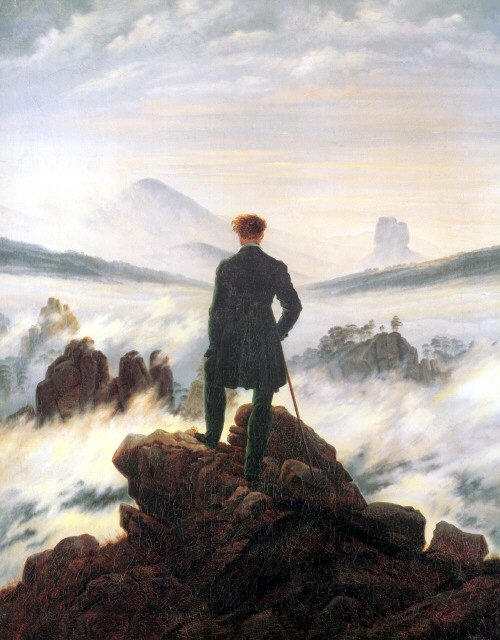
Wordsworth loved mist precisely because of the manner in which it prevented him from seeing.  The 'Mont Blanc' sequence in The Prelude is when he is at his  most eloquently disappointed by 'the desert of the real'.  For days he climbs The Alps, his anticipation swelling with every crunching step towards the summit. The clouds part.  The summit of Mont Blanc is lain before him in bright sunlight. And, he 'grieved to have a soulless image on the eye.'  The hierarchy of perception dictates Wordsworth's relationship with the place. He expects an aesthetic experience, but he gets a natural one.  He prefers the mist.  It is intellectually fructifying.  The boundlessness of his imagination is free to envision this moment of communion in numerous ways, but Wordsworth's 'real' experience reduces it to one.  Mont Blanc is revealed. It is bald, plain. Only on the descent do the limits of his imagination begin to shimmer once again as they fail to recall the reality of his memory.  As his descent continues, he is able to take ownership of the place by forgetting its actuality.  In an inversion of Friedrich's The Wanderer above the Sea and Fog, Wordsworth descends below the clouds so that he can become the self-proclaimed conqueror of his land once again.
There is something unpleasantly coercive in Wordsworth's relationship with nature. He seems to want to not want it. His idea of it is more important.  Nature cannot exist on its own terms, and here it seems to become a psychological construction.  A theatre in which Man may celebrate his divine powers of creativity.  A proscenuim to frame his own ideology. 

I love fog.  Obviously not because the air is even more difficult to breathe than normal.  And not because it keeps a 'soulless image' from my eyes.  Or is it?  I think I love it because it randomnly selects and deselects aspects of the landscape that we would never think to rest our eye upon.  Unlike snow, it does not come to rest in predictable places.  In seconds, it can change everything.
I should be sensible and keep my run short.  But I can't not divert into Greenwich Park with the heath looking so magical.
Erasure and focus. Telescope and microscope. Grayscale and technicolour.
Fog alters the way that we can look at a place. But if you close your eyes, it sounds different, too.  The acoustics are not so eidered as they are by a quilt of snow.  It's more like a century or two of forest has sprung up around you. Open spaces are suddenly private and enclosed ones.  Pathways in your vision suddenly close and your eyes must find a new route. Like the landscape has become braille, you have to feel your way through it.  
When I first enter the park it is a disappointment; this is not why I am going overdrawn in my energy bank.  Too much of it is hidden from view. The path goes off in three directions, but they are so stunted that they look more like the tines of a fork than long and winding waythrus.  Just like on the Heath, the fog has landed on the ground like dollops of mashed potato and in seconds I'm through and the landscape is renewed.  
Canary Wharf, a clutch of buildings I usually dislike because of their sturdy dominance of the London skyline (like two tectonic plates of Meccano collided a few millennia ago), looks fantastical.  The fog rests so heavily that the ground and the river that separates us has disappeared altogether leaving the buildings to float above this sea of clouds.  The sky is still pink from a setting sun.  The interior lights of One Canada Square usually look steely-white against a night sky, but the grey of the fog does something altogether different to them.
Grey, even as a metaphor, is supposed to signify absence.  Without colour, without character, it is grey.  But the grey of the fog seems to lend itself to its surroundings.  For this dusk, the lights of One Canada Square sparkle with a deeply affluent gold.  The building next to it is trimmed with neon tubes of shimmering teal.  These are the same lights that have always been there, so the grey of the fog cannot be 'no colour', but one that gives itself to others. Grey is only grey because it has given itself away. It has made this magnificent cloud city.
I turn my back on this sight and head for home, into the mist.  And as I run into another cloud on the land, for the first time in months, I feel not like I could go on forever, but at last, that I might want to.

Sunday, 9 October 2011

"Cry 'Havoc'!"

Handle, up; it honks like a goose as the lock is engaged into the PVC doorframe of the porch - I spin the key and then fold it neatly into my shorts.  The house is on a steep hill at the North end of Brighton.  The sky is clear, odd on a day as hot as this - with miles of view you expect to see gossamer films of mist, but it’s a day when all the landscape can see itself in itself.  The Isle of Wight must be fifty miles from here, it looks just as close as Worthing pier.  Both shimmer in the heat.
I have lived here for three years.  It is a big house, a beautiful one, but it isn’t mine.  It has more character than any house I have ever seen.  It has a solid oak staircase.  In every window there is stained glass, and in every window pane the stained-glass design is slightly different.   The garden is full of mature roses, peonies, lilac, the borders are lined with sweet woodruff and lavender.  But these are someone else’s plants, someone else’s idea of what a garden should be.  This was the forever house.  It was one to grow old in.  How could it possibly have lived up to that?  
At the last house, I had made a garden out of nothing.  It began as builder’s rubble with a thin skin of recently unrolled turf. After a couple of years, on almost any day, you could see jays, wagtails, greenfinches, sparrows, robins, wrens, blackbirds, goldcrested finches, blue tits, rooks, hedgehogs, jackdaws, swallows, great tits, dragonflies, toads, hummingbird moths, or bats.  Here, there is nothing.  Pigeons occasionally land in the centre of the lawn like they are counters on a square of Snakes and Ladders, and in seconds, with the look of one who has mistakenly grabbed someone in the street they thought they knew, they are gone. 
The house is empty and leaving it always feels better than returning.
I am not a very good runner.  I have a big appetite, though.  I want to run more than I can, and for the moment I see this as a physiological desire, like hunger, rather than an emotional one.
I climb to the brow of the hill and turn north onto an artery clogged with the earth's adipose deposits, cars.  I imagine the queue of traffic running for two solid miles all the way to the NCP Car Park in the town centre.   Brighton Sundays, everyone seems to want them.  Not me, not today, it’s air I want, not sea.
§
After a mile up this road, the traffic suddenly turns hard East or West and you are left suddenly alone.  A couple more hundred metres and you cannot hear it.  A democracy of pathways lead you towards the long peaks from which you can see most of Sussex and Surrey.  The South Downs are an escarpment of chalk deposits, folded like soft dough, some sixty million years older than either you or I.  They stretch for hundreds of miles.   The nineteenth-century poet and naturalist, William Henry Hudson wrote that ‘during the whole fifty-three mile length from Beachy Head to Harting the ground never rises above a height of 850 feet, but we feel on top of the world’.
It is summer, 2006.  I have been running for a few weeks, eight perhaps, and I am able to do about six miles.  I have been here before, many times before.   
My body is about to reach a very familiar point when an injury, so common as to be named after the activity itself, will break cover to stop me in my tracks: runner’s knee.  Not today, though - and probably not tomorrow, but somewhere in these long grasses I know it is stalking its prey.
Weight has been falling away.  I haven’t been trying to lose it, but I find that it is being burned quickly by something.  People often think that running is a good way to lose weight, but it isn’t really.  Most of the energy that’s consumed in the run is glycogen that will be replaced by the next meal or two you eat.  It is a little like saying that a car has lost weight in it's drive across town because it has used some petrol.  No, I think that both have the same cause: I want to run because of something else, I am losing weight because of the same ‘something else’. 
The Romantic poet, Charlotte Smith, devoted a sonnet to this place - although like many Romantics, the place became a means to explore herself.   In ‘To the South Downs’ she hopes, 
Ah! Hills beloved - your turf, your flowers remain;
But can they peace to this sad breast restore,
For one poor moment soothe the sense of pain,
And teach a breaking heart to throb no more?
While the lexis and lyricism may seem recognisably, perhaps tiredly, melancholic - the rugged syntax, a jigsaw piece forced into the wrong position - the poem knowingly sees in this place an inoculation against something that cannot be borne.  The poem ends bleakly in a wish for the oblivion of death as a liberation from pain.  A desire for the heart to stop ‘throbbing’ is also found in Hardy’s 1898 lyric to sexual frustration. ‘I look into my glass, / And view my wasting skin, / And say, “Would God it came to pass / My heart had shrunk as thin!” If only we might stop feeling, both poets seem to say.
But here, when I touch the first grass of the Downs, I feel like I have stepped onto a web.  That my movement has set it tingling.  That my footsteps are like tiny tremors, detectable for miles around. That this spun fabric is all connected and it can see me from every angle.  That I have left one community and am communing with another quite different one. That it is a labyrinth in which I am not lost.  That it is not today, but everyday, any day in the past or future. The last thing I feel is the desire for it to end. To not feel this.
In mile three, I am still headed away, and I arrive at The Dyke.  How many times have I been here?  A thousand, perhaps? I am used to telling people that I go there, not for the hundreds of square miles of view of the Sussexes, but that it is the same place and I have never once seen it looking the same.  I know every pathway and wobbling styal, even today I could find some puddles and mud.  The acidity of sun-baked cowshit pinches at my nose.  In the distance I see Havoc with his owner tearing behind after him.  I chatted to the man a couple of years before.
'Havoc? Why Havoc?'
His eyes bulged.  He took a breath. ‘ “Cry, ‘Havoc!’ and let slip the dogs of war.” Julius Caesar, Act 3.  Do you know it?’
'Yes.' I didn't.
'And yours?'
Feeling suddenly inadequate.  'Oh. He's called Ben.' Hearing his name, he looked up at me.  I scratched his head. Mr Havoc seemed unimpressed.
On days like today, the Downs take on a strange timpanic resonance.  As my feet strike the ground of this 500ft crease in the landscape it sounds empty, like my footsteps may be heard for miles around - perhaps even in the villages on the Weald, below.  People will have been farming the land here for thousands of years.  Others in that time will also have wondered at this echo from within the hills, it makes the earth seem unreal somehow.  And with every beat of this drum a breath of white dust is thrown up by the chalk as it reaches the point when it cannot separate into any more constituent parts.  Only water and unthinkable tectonic pressure, an event so dramatically catastrophic - just like one that will have made these hills reach for the heavens millions of years ago - will bring these micro-grains together again to form solid ground.  A new ground for the future, one whose landscape is unimaginably different to today’s, but is fundamentally made of the same parts.
It does not occur to me that, of course, I am not thinking about the landscape at all.  After only a couple of hundred metres my runner's leash is at full stretch.  I turn my back upon the world, retracing my steps South, and home.
It has only been a few weeks, but I am already addicted to this powder.  At first it was free, but I am beginning to realise that it has a price.  It is expensive, and I cannot afford it for long.

Thursday, 29 September 2011

Welcome to 'The Zone'

Today was a strange one. A day off yesterday so a run was on today. I had a very light breakfast.  Worked a little. Then, 

ENOUGH! It’s Sunday for God’s sake.  I put on my trainers, said I would be gone for 60-90 minutes and stepped out the door, not knowing how far I was going to go. 
The Ferrier Estate, in glorious full colour
The first mile passes a little quickly.  Am I going a bit fast?  Then something odd happens.  Instead of turning up towards Blackheath, to snake up to it through Atkinson-Grimshaw land, I find that I have gone straight.  The road is awful (Lee High Road).  I drive on it all the time and I know that it is shite and has nothing whatsoever to offer me, but here I am.  Today, for some reason, I don’t mind the noise at all and am driven by wanting to do something a little different.  So I do.
After a mile, I turn North off the main road and head towards Kidbrooke.  I have driven through here a few times, but I don’t really know it.  I have seen the council estate from the road and it looks, huge - like a city in itself, one that it is about to collapse at any moment.  Mile 2, done.  At last, I touch concrete that I’ve neither seen nor sensed before.  The road is deserted.  The estate is boarded off, solid metal fences block pathways, deserted flats have had doors and windows covered by huge metal panels, their numbers graffitied on them in freehand figures.  I suppose it is all being demolished.  The road is quiet.  It is straight, and it is long.  I run down the middle of it.  
This landscape is amazing.  This is life in black and white.  No, that’s wrong.  This is life in grayscale.  There was a deep cerulean sky, now there are only varying shades of colourlessness.  The buildings are such a deeply hostile grey that the sap the colour from the few trees that surround them. 

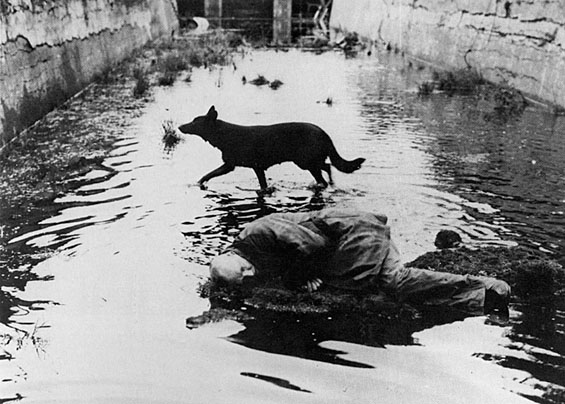
They are all connected by intestinal walkways.  Some have prosthetic growths, huge grey boxes that hang from the side of the blocks.  Everything is piped, vented, rivetted.  Some are connected by ladders that were once painted pink, a long time ago.  They have hoops all the way up to protect a climber from falling.  But to look at, the first rung would crumble to rusty ashes if someone was to step upon it.  The concrete on the blocks is so jaggedly ridged that it would rip open your skin just to feel it.  Tarkovsky would not have needed an art-director to shoot here.  No set dressing would be necessary.  Welcome to The Zone.

I circumnavigate the entire estate.  It is going to be developed.  Everywhere are banners and borders shouting that new life is about to begin.  But that is all.  I run for well over a mile around the complex, and I see no one.  A bus goes by.  What the fuck for?  Nobody’s here. The bus is empty.  I find it hard to believe that anyone was actually driving it.  My iPod has been on random, and this is the moment that I first hear Ghostpoet’s ‘Survive it’.  It is a sort of ambient dub-step and it sounds so much like it belongs here that it is sweating from the pores of these condemned buildings.  Curtains hang in windows, not ‘hang’, but hang from maybe two hooks.  My God!  Some of these flats are still occupied.  Some have no windows - I don’t mean that they have been smashed.  I mean they have no windows.  No glass.  No frames.  Just a wide open aperture looking out onto an erupting A2.  I see a poster, so big that it is the size of one the blocks.  
‘For today, for tomorrow, for the future’.  
I don’t know what this means.  For whose future?  The council tenants that have been turfed out so the valuable commuter land could be sold to developers?  
The developers are making space for the new buildings. Some areas on the eastern side of the site are fenced off by solid panels, green and glossy like trees just into leaf. They are eight foot tall and plastered with empty marketing rubbish like 'for greener living'. There are pictures too.  The boards continue in an unbroken motif for hundreds of metres. 
  1. A woman, in her twenties, is hunched over her bike. She concentrates hard. Her cheeks balloon slightly as she exhales hard into a chimp's 'ooo'. She is wearing oyster-coloured Lycra.  Her earphones are clipped and taped efficiently to her body.  She concentrates hard on her balance.  But she is surrounded by blurred taupe.  She is inside.  The bike is in a gym that doesn’t exist yet.
  2. The next is of a young man. He lies back on some green grass, fingers interlaced behind his head. He has a blissful, or is it a smug, smile on his face like he is being sucked off out of frame. He wears a huge pair of silver headphones. His eyes are closed. 
  3. Next, a Taxi, stylistically blurred, speeding through the reddened night of London's streets. 
  4. Then a landscape with … a blue river.  A nondescript one.  A generic one.  The simulacra of one.
  5. And finally, the Cutty Sark - a tea schooner in Greenwich which has been under cover from public view for at least four years. 
All of these images are an absolute denial of place. One works hard to escape on a stationary bike, performing with considerable intensity and focus, an exercise that will get her nowhere. Another shuts his eyes to close himself off from the world and drowns out the noise with fuck-off ‘phones. The other three are definitively about not being here. And all this primary-Technicolour seems like it is a distraction. A magician's sleight of hand to distract visitors from seeing what their luxury new apartments are destined to become.  Live here long enough and you will see it become The Zone once again.
Then something odd. On my left is a height cross-wire fence looking out on to some fields. Right by my head as I bounce along is a squirrel. It runs with me on the top of the fence. At first I wonder if I have startled it and it is trying to run away from me, but it is stuck in the one-dimensional world of the wire of the fence-top. But it could have run the other way. It has a hazelnut in its mouth. It matches my pace for a few metres, then like it’s fallen from a great height, splats its limbs at a tree, quickly climbs and is gone. Does it gambol like this because the landscape is so static and unpeopled. I have had enough of this devastation and I need air. I have a narrow desire to get up high somewhere.   I head North out of Kidbrooke and the first thing I see is a giant Homebase.  I laugh aloud - what a terrible advert for that shop to have such a state on its doorstep.
A couple of days before, Adam and I were walking out of Hilly Fields and he asked what that hill was in the distance.  I hadn’t the least idea.  It took us a few minutes to work out that it had to be the old A2 and Shooter’s Hill.  It looks so big with a huge watertower on the summit.  I don’t care how far it is, that’s where I’m going, now.   
After the run I check the climb.  Had I known it was 500ft, one of the highest points in London, that the climb went on for over a mile, would I have done it?  Hmmm...
The climb seemed interminable and I was reminded of the fact that for well over a thousand years, marauders have hunted here, preying upon exhausted horses and their rich passengers.  They were still doing it 800 years later when Dick Turpin hunted here. Pepys remarked upon seeing the deterrent of men hanged from gibbets (11/4/1661).  But none of this stops me from wanting to run to the top of the world and look over the precipice.  To see land.  To see something that isn't concrete.  To touch a void as a remedy to all this tightly-compacted civilisation.

Silent comrade of the distances,
Know that space dilates with your own breath
(Rilke)