Friday, 14 June 2013

My Uncle Jim - barefoot Marathon-champion.

No. 9 - Jim Hogan.

I was skinning in Lewisham today.  And, as I crept along some of the fiercest of surfaces for barefooters (tarmac with protruding gravel), I wondered how my uncle ever coped with this.  My uncle is Jim Cregan, though he ran under the name of Hogan.
My uncle was born in rural Limerick in 1933 and when he was a boy he discovered both a passion and a talent for running.  So naturally, his mama took him off to the local Niketown, bought some massive spongy trainers for him to run in, he slipped them on, and the rest is sporting history.  No, there wasn’t a whole host cash sloshing about in Southern Ireland before the war.  He had no shoes, so he learned to run barefoot. 
I’ve recently been reading some of the debates about barefoot running that I try to avoid, and the reason that I try to avoid them is that I don’t really think that there is much to debate with people who think that ‘better’ running is ‘faster’ running, because I think that better running is the running that makes you feel good; the running that doesn’t hurt or injure you, and if that means running barefoot, then that’s what you should do. 
In one of these debates, about a ridiculous experiment to decide whether forefoot or rearfoot running was best (why does this matter?) one of the trollers said something along the lines of ‘If you can just show me the marathon runner that won barefoot, maybe I’d be prepared to listen.’  And I remembered Uncle Jim.
Jim Hogan was not a barefoot exponent.  He mostly ran barefoot, but his trainers did manage to wrestle him into trainers.  But, he just did not like the fact that he couldn’t feel the track anymore when he ran in them.
My uncle, managed to win marathons barefoot. He competed in two Olympics. He held the world record for the 40K.  In 1966, he won the European Championships, running it barefoot, in just 2.20.
He is not so well now, but is celebrating his eightieth birthday.  He gave up running only a couple of years ago.  
What a hero!
God bless you, Jim - and Happy Birthday.


You can buy his book here.


Tuesday, 11 June 2013

Knot! (I thought I had a running injury, but it was an admin one).


At first it was a dull pain in my calf.  As the run continued, the pain became sharper. After another half mile I began to alter my gait to ease the pain. Then I realise, I am injured.

When I get home I find that my soleus (the smaller calf muscle that emerges from the achilles tendon)  has gone into spasm and has a lateral anterior knot.  I attack the bulge with my thumbs but it won’t soften.  The knot is tangled and tied tight. It's painful and it is a very unusual place to get one.

The acid-bitter frustration of injury is familiar territory to every runner. It is exacerbated by the fact that this time I was being careful and taking it easy.  It is unfair, somehow.  I have been drowning in exam papers.  I have been trapped inside marking 107 scripts (214 essays) and keeping up with emails and the kind of report writing that is the mainstay of so many peoples’ jobs.  I need this time out.  I need to be able to escape from this snowy mogul of paperwork.  I need air. Desperately. 

The next day, I continue kneading at the knot.  It's stubborn, so I decide to skip my run and rest, instead - more work.  Two more days go by (of more work), and even though it still hurts, it is softer.  I head out for another run; slowly, carefully.  The muscle is not happy but I manage the run OK. 

On the following day, a Sunday, frustrated with my coralled existence (of having to perform a pointless administrative task of uploading a reading list, item by item, to a website - that, if it were a friend it would be one of those 'difficult' ones that wants precisely 2/3 of a spoon of sugar in their tea) I decided to walk, not run, up to Blackheath.  It is only a couple of miles.  The sun is shining and I imagine that this low-level activity is good for the knot that is still quite painful.  Halfway there, I have a sudden, sharp, stabbing pain in the upper part of my calf.  My other calf muscles (the gastrocs) have now gone into spasm, too. 

I grab my leg; the knot is the size of a squash ball.  How can my fitness level have dropped so severely that I can’t even walk a mile?  It wasn’t the discomfort that bothered me, but the fact that with every pulse of pain I was being reminded of the fact that I would have to spend even more time inside, at my computer, on the couch, marking.

The following morning I manage to get into my local physio.  I found this amazing fellow when I was training for the marathon.  Since then I have clung to him, limpet-like. I start telling him what has happened and as I’m doing this he begins to smile.

“Why are you smiling?”
“Is your back stiff?”
“Yes, a little, but nothing like my calves.”
“I think it’s your back.”

He was right, too.  I didn’t have a running injury, but a marking one.

As I sat for hours, marking, inputting data, screen-adminning, my lower back stiffened, hardened, swelled, slowly disrupting neural pathways from foot, to leg, to trunk, to spine. As the signals travelled up and down they became garbled and interpreted threat where there was none, so my lower leg (the end of the communication line) went into panic to protect itself from the perceived hazardous activity of walking a mile to Blackheath.

Sunday, 2 June 2013

The Touch of Sweet Liberty (Skinning in Paris)


Montparnasse - Paris
The banks of the Seine are overflowing.  As the tourist boats amble by the Louvre and the D’Orsay, wavelets lap onto the cobblestones, combing the emerald hair of the seaweed forth and back. The day has been long. A friend’s birthday, a short night’s sleep, and an early dash for the Eurostar. Paris! 
Always keen to walk, I made it from Gare du Nord to the hotel and then calculated why I felt so exhausted - I had covered over five miles with luggage. I say to myself, ‘I don’t want to run’. ‘I can’t run’. ‘I shall run’. Then I do run.
Here on research business, I have hitched a ride with the University of Kent’s Summer School party that are journeying to spend two weeks in Paris.  First, I meet Olly - a smartly turned-out (if a little bleary-eyed) film graduate, who - he tells me - hasn’t slept at all.  The Summer School consists of Kent’s bright young things and they seem an impressive bunch: enthusiastic, friendly, alert, interested, knowledgable, and they cut quite the dash. Once we reach Paris, we part company - they are off for a lecture at the Pompidou Centre this afternoon, and who knows what other treats in the next fortnight. I wave goodbye and wish them well. I begin my walk across the city.
When I finally arrive, the last thing I feel like doing is running.  And no matter how many times I go through this thought process, I never quite fully remember that this is exactly the point at which I SHOULD go running.  If you don’t want, if you don’t feel like, if you can’t be arsed, then you need a run.  I would do well to remember Rousseau’s mantra - from his Reveries of a Solitary Walker  'These hours of solitude and meditation are the only time of the day when I am completely myself’.  Written mid 1770s, the book was incomplete at his death and has had a slow-burn effect since then on anglo/french philosophy and culture.  It is now counted as an influence by psychogeographers, situationists and new nature-writers.  For Rousseau, walking was a means of demarcating for himself, a kind of pleasure bought through self-knowledge, that society with others completely denied him. It was an escape from ‘the torrent of this world’.
I’m in Montparnasse.  I slip on my rubber soles and head out onto the streets.  I would go barefoot but I don’t know the territory.  As I turn the corner, I see that the ground is smooth, so I shuffle off my shoes, crumple them up in my hands and start running - two lads laugh as they see me do this.
The sun has been hot all day, but under foot the concrete is quite cool.  The instant I start running, feeling the solid ground beneath my feet, I begin to feel less tired.  I establish a comfortable pace, listen for the right kind of silence from my worn out feet, and settle into what is going to be a meditative pleasure.
I dodge into Luxembourg Gardens - mistake!  The pathways are wide and consist of sharp grit. Few would keep a straight face watching me jiggle in pain on it.  I head back for the streets, dancing between couples and kissing gates, and slip my shoes off again.
On the street, the crowd is thick with amblers and as I dodge between them (all the time trying to eye the unfamiliar  ground for dogshit and broken glass), I find myself making snap decisions about which route take, entirely down to which lights are on green or red.  The optimistic-me thinks he’s improvising, he's a gay flâneur, the pessimistic, is not so sure, and the image of a rat in a maze, following signals flashes into my head.
On my right, uphill, is the huge-domed Panthéon.  It houses, amongst other things, the world's longest Foucault's Pendulum.  Throughout the day it rotates so a clock face can be placed beneath it and it can be used to tell the time. But,   Foucault discovered that it wasn't the pendulum that was changing direction; it swung along two dimensions only.  It was the earth beneath it that was spinning in space.  The entire world moves beneath us, but the pendulum's fulcrum remains static.
I had no idea that so many tourists (of which I am one) would be drawn to this area.  I start taking a long arc of pavement, finding a pathway through the crowd by running between them and a public exhibition of cycling photography.  I am uneasy doing this, it feels like photobombing someone's serene contemplation in a gallery.  There’s space again, so I step from the tunnel. And in this city of millions and millions, there is Olly, right in front of me. I feel suddenly present - no longer the observer. Coincidence destroys the gossamer veil of anonymity.
For the rest of the run I’m in a sort of haze.  The only punctuation to this is when I joust by another runner who exchanges a warm smile with me (they don’t do this in London). Her day is getting better, too, it seems.  Our smiles are the acknowledgement that in this bustle, this clamour, we have both sought out Rousseau’s ‘pleasing disquiet’, and have felt the desire to touch again a sweet liberty we once knew. 

Wednesday, 29 May 2013

Earthing and the 'Bare' Barefoot

I have more running shoes than I do regular ones.  In fact, add up mine and my partner's regular shoes and I still have more running ones.  I like running in different shapes, types and heel drops.  About half of them are 'barefoot' shoes.  By this I mean that they are zero-drop (have no heel-raise at all), and have no cushioning, just 2-4mm of rubber to protect from grit and stones. But of all my shoes, these are the ones I use least.  Don't get me wrong, Vibrams and Vivobarefoots are great shoes, but they can't beat the onslaught of sensory feedback that the 200,000 subcutaneous receptors in your feet are itching to provide.  But there's more...

There is something about the bare barefoot, something shamanic, yogic, some electrical neuromagic that works between the soles of the feet and the brain.  The feeling after a barefoot run is somehow different to a shod one.  I always knew it was.  Could this be the reason?

There is a movement called 'earthing'.  Its basic tenet is that our bodies now spend a great deal of time disconnected from the earth. In evolutionary terms, this is a recent phenomenon.  It is thought by the earthers that our bodies build static, positive, charges relative to the earth.  Earthing the body, returns the voltage differential to zero and this is thought to provide benefits for mental and general well-being.  Some evidence for the health benefits of earthing has been provided (and you can read about it here.) But there has been a good deal of bad science, too.  More evidence is needed to substantiate the claims that "Reconnection with the earth’s electrons has been found to promote intriguing physiological changes and subjective reports of well-being." (Journal of Environmental and Public Health Volume 2012, Article ID 29154).  

Some studies have begun looking at the way that barefoot running shoes change our natural gait.  Vibrams have been linked with an increased propensity to heel-strike, for example (see Pete Larson's blog entry, here.

For me, earthing seems intriguing and provides an answer to a difference of experience that I had already noticed between barefoot running and running in barefoot shoes.  I would love to know more about the real physiological and psychological impact of earthing.  


Monday, 13 May 2013

"KINDLE!"


[this post has nothing to do with running]


How do you feel about your Kindle? I can't fall in love with mine.

It occurred to me today as I sat in my bath reading Tolstoy’s The Cossacks that my Kindle makes me feel uncomfortable.  Why?  It has so much going for it.

1. It is lighter than a book.
2. It is backlit, so you don’t need to sit at awkward angles to catch the right light on the page.
3. It fits in a jeans pocket.
4. I can carry my library around with me.
5. I can make the font bigger - tiny font was the reason that it took me about fifteen years to get round to reading Crime and Punishment.
6. I can highlight passages that I can easily refer back to
7. I have no emotional connection with it, so when I do finally drop it in the bath I won’t care.
8. you can flip back and forwards between footnotes and pages.
9. you can 'search' a book.

When I first thought “You know, I just don’t like this thing.”  It was because I was sick of the light catching the entombed “KINDLE” logo that shouts out at me from below the screen.  "Kindle!" it screams, with every glint of light, like a crap toothpaste commercial.  I bought the thing, is it really necessary to advertise itself to me?  I have thought of attacking it with a piece of sandpaper but that would ruin it.  After that I started thinking that all the reasons I thought I liked the KINDLE! are actually quite tenuous.

1. Books aren’t heavy.
2. The contrast level between ink and page is still not matched by the KINDLE!.
3. But I never carry it in my jeans pocket.
4. I have never wanted to carry a library around with me.
5. Fair dos - this one is just better.
6. I highlight so many passages that it becomes completely meaningless to highlight passages. When I write in one of my books, I know that I really mean it.
7. I have never dropped a book in the bath, and what’s more, I like having emotional (real) connections with things.
8. Real books are much quicker at this.
9. ... really slowly and unreliably.

I’m also currently reading Susan Greenfield’s The Private Life of the Brain, and on the cover is a Penguin logo.  Is this any different to KINDLE!?  At first I thought not, then I realised that it differs in a number of ways.  The Penguin logo is not on every single page of the book, when I’m reading I’m not distracted by the Penguin.  Even if the logo were on every page, Penguin were the organisation that invested time, energy and money in the publication of this book.  By paying for this book I’m contributing to the continuance of a company that wants to produce more excellent books like this one.  I am also paying tax. Penguin pays its tax.  The shop that I bought it from pays its corporation tax. KINDLE!, does neither of these things.  It contributes to a fast-forming monopoly and does not use that money to invest in the writing of the future.

My KINDLE is going to be my emergency reader from now on.  I have flirted with the digital life, so it’s vinyl for me.

"No, it's not you. It's me. I'm just not ready for this level of commitment..."

Friday, 26 April 2013

Hardy and the Birds


"What's on the wireless?" he said.
"About the birds," she said.  "It's not only here, it's everywhere. In London, all over the country. Something has happened to the birds." 
     When Daphne Du Maurier’s short story was first sent to her publisher to read, he told her it was ‘a masterpiece’ (Victor Gollancz was not often forthcoming with praise).  I am ashamed to say that I have not seen the Hitchcock film. The story is set in Cornwall, after the Second World War, a small family is trying to make its way working the land, and working for local landowners.  The tension in the story builds slowly from one that tells of freak encounters with nature to becoming one about the terrible dread of an all-out apocalypse. The birds – every one of them, gulls, wrens, sparrows, hawks – attack the countryside’s inhabitants.   Flailing arms, fires, shotguns and cars are useless against their sheer numbers.     Radio broadcasts from London cease.  Flocks bring down aeroplanes.  They smash through windows and kill householders.  Neighbours are found dead.  We never find out why.
     Their behaviour is inexplicable.
     They are birds.
     When I used to run along the seafront in Brighton there was a sight, familiar to us all no doubt, that I tried countless times to photograph but it was uncaptureable.  Waves of starlings would tidally swoop and swirl, sometimes for hours, around the bombed-out remains of the West Pier.
     You cannot grasp in a frame the soaring and stunning four-dimensionality of this dance of clouds. As Ruskin said of water, 'It is like trying to paint a soul'.  The sight is an overwhelming one: centrifugal spinning and turning like ink in water.  This movement cannot be reduced to the stiff and flattened dimensions of a photograph.
   We look up and witness that.  I wonder what they see when they look down at a crowded mass of 35,000 people in their two-dimensional world? Do they watch them shuffle through the funnel of the marathon startline like shapes on a piece of paper?  We share much experience with birds: we eat, we sing, we shit, we live, we die, but there is no language that can describe the wonderful fluidity of this sight. They are just so different from us.
      Taking 'time' out of the equation, we pretend that we live in three-dimensions, but we don’t – not really.  We do occupy the third dimension (of course we do), but we don’t regularly take advantage, or make much use, of it.   I was lucky enough to go to New York a few years ago, and there it struck me for the first time how very flat our lives can be.  Being shown to my hotel room I had to equalize in the lift, and then decompress on my flight back down to the lobby. Throughout the few days of the stay we were always moving across, along, high-up and all-the-way back.   It is the only place that I ever really noticed this; elsewhere we just seem to exploit two dimensions.  Edwin A. Abbott’s satirical Flatland of 1884 is a gem.  It is a post-Euclidian fantasy of inter-dimensional travel where beings (shapes) who live in the two dimensions of Flatland struggle to understand the possibility of a third.  The polygonal hero meets the Sphere who tries to explain the third dimension.  To do so, they travel to one-dimensional Lineland, and no-dimensional Pointland, where they appear as an idea in the head of its only inhabitant. It is like Plato’s Cave in The Republic where the ‘truth’ teller is ultimately punished for possessing dangerous and fantastical ideas.  But Flatland is also about our inability to see beyond the dimensions of our own comprehension.  The 2D and 3D dimensional-tourists do actually appear to the inhabitants of Lineland, for example, but only as one-dimensional lines (not the squares and spheres of their ‘real’ bodies).  Ultimately, the novel is a satire that exposes our inability to perceive that which we are not programmed to see.    Hardy also tries to make us aware of such perspectival partiality in The Mayor of Casterbridge in describing the eponymous city: ‘To birds of the more soaring kind Casterbridge must have appeared on this fine evening as a mosaic-work of subdued reds, browns, greys, and crystals, held together by a rectangular frame of deep green. To the level eye of humanity it stood as an indistinct mass behind a dense stockade of limes and chestnuts, set in the midst of miles of rotund down and concave field.’ Hardy does his best to subsume the mysteries of brickwork, roads, roof slates, and the windows of the townscape into a kind of avian cognitive representation. The brevity of the language may appear half-hearted but the simplicity and directness of it is its strength.  The bird’s eye description uses only visually-descriptive abstract nouns, for humanity the trees’ proper names are reinstated - correct taxonomy is a human endeavour, not a natural one.
     Much later, in his notes that would become the Philosophical Investigations, Ludwig Wittgenstein, always a savant philosopher riveted by the powers and peculiarities of language, wondered

25. It is sometimes said: animals do not talk because they lack the mental abilities. And this means: “They do not think, and that is why they do not talk.” But – they simply do not talk. Or better: they do not use language – if we disregard the most primitive forms of language. – Giving orders, asking questions, telling stories, having a chat, are as much a part of our natural history as walking, eating, drinking, playing.
                                                                              Wittgenstein – Philosophical Investigations

     They do not talk means only that they do not talk.  Did Wittgenstein really believe that they did not use language, that they did not communicate?  If like me you have run in a field of crows and met their stare – and I am sure you have – you could not even consider that they do not think.  The stare is not unidirectional, it is returned.  We may see ourselves in it, but there is something else there too.
     In 2008 an ongoing study was first reported that had been conducted at the Washington School of Forest Resources in which crows were trapped, banded and released by mask-wearing staff. They discovered two surprising things. First, that after five years and counting, banded crows still remembered the masks and would hound and dive at the staff. Second, that crows that were not involved in the experiment in any way also joined in the angry mob that jeered the mask-wearing staff over a mile away from the original incident.
     John Marzluff went so far as to assert that some of the crows were able to ‘make and use tools, forecast future events, understand what other animals know, and — in our [experiment] — learn from individual experience as well as by observing parents and peers’.   The birds were capable of ‘advanced cognitive tasks shown by only a few animals’.
     So they do not use ‘language’ professor Wittgenstein, really?
     Hardy again dramatizes the complexity of our anthro/avian relationship simply and effectively in the opening pages to Jude the Obscure.  The young Jude is employed by the farmer as a living scarecrow – they had gotten used to the static and silent kind.  The young Jude, though, empathizes with the birds
"Poor little dears!" said Jude, aloud. "You SHALL have some dinner - you shall. There is enough for us all. Farmer Troutham can afford to let you have some. Eat, then my dear little birdies, and make a good meal!"    They stayed and ate, inky spots on the nut-brown soil and Jude enjoyed their appetite. A magic thread of fellow-feeling united his own life with theirs. Puny and sorry as those lives were, they much resembled his own.
     No reader of Jude the Obscure forgets reading it.  The punishment meted out to Jude in the novel is so unrelenting that Claire Tomalin recently described the experience of reading it to being continually slapped in the face. In chapter two of the novel, Jude’s empathy with the birds reveals him as one not fit for the battle of modern life upon which he is about to engage. Civilization requires disconnection from nature, and this is Jude’s tragic flaw: he is of the earth, yet he seeks out the city and society of Christminster.  The city, just like Farmer Troutham, does not care for this ill-adapted and unfit specimen.
     When nature meets culture they do not speak in the same language.
     For me, one of the harder things about living in London is the litter. Litter is such a strange word. It sounds clean, like someone has crumpled up a blank piece of paper and tossed it aside to become a tumbleweed snowflake. When I say litter, I mean the mysterious and variegated palimpsest of stains that tattoo the pavement like some antique map, liquids that had flowed-across or impact-splattered onto the concrete; or Big Mac boxes and Red Bull cans, flattened and tyre-tracked; a laceless shoe; jewels of broken glass; a Capri-Sun sachet with a pink straw extruding from it; blackened chewing gum; broken elastic bands; mouldy trays of tomatoes; even a bed – it was a double.   All of these have featured in the ‘still life of modernity’ at the bottom of my road. The worst of these, though, is one of the most regular offenders: chicken bones.  Stepping on one is utterly gruesome. It was once a body, now here is a single piece of it. It has been held in someone's hand - traces of the grease are probably still on their fingers.   It has been in someone's mouth. And now it is tossed aside. Under your shoe, it crunches to the marrow in that flint-sharp way that only chicken does and you are now carrying a little piece of this confluence of biological history with you.  The interconnection is complex, intimate, somehow wrong.
     There is a convergence of chicken opportunities at the turn of our road.  There is a KFC (which as Jonathan Safran Foer has recently noted, now stands not for Kentucky Fried Chicken, but for nothing - it is just K.F.C.). There is also a Chicken ‘heaven’, ‘paradise’ or ‘cottage’ - I could check the name by walking a 100 yards down my street, then write pages on the trickeries and nuances of their shudderingly awful and misleading brand name and happy-chick logo, but they just don’t deserve the effort. In a moment of weakness – I think it might have been my birthday – I called in there for a veggie burger and chips.  It wasn’t very nice.  At 4am I was feverishly vomiting the lot back up.
     On another morning I woke up to find a rib on my balcony. I did not check but I don’t think it was a human rib.  It was cut cleanly and there was nothing on it.  A machine could not have removed the meat from this bone more efficiently.  I live several floors up so I don’t think a drunken (or sober) passer-by could have managed the throw.  It must have come from the sky.  But from where?  How far had it travelled?  Where was the rest of its body?  Dispersed throughout the take-aways of Europe?  In a freezer somewhere?  Buried and forgotten by some dog in a suburban garden?  Eaten?
        John Clare was fluent in the exploration and the sinewy complexities of our relationship with the natural world. This is from ‘The Badger’
The dogs are clapped and urged to join the fray'
The badger turns and drives them all away.
Though scarcely half as big, demure and small,
He fights with dogs for hours and beats them all.
[…]
He tries to reach the woods, and awkward race,
But sticks and cudgels quickly stop the chase.
He turns again and drives the noisy crowd
And beats the many dogs in noises loud.
He drives away and beats them every one,
And then they loose them all and set them on.
He falls as dead and kicked by boys and men,
Then starts and grins and drives the crowd again;
Till kicked and torn and beaten out he lies
And leaves his hold and crackles, groans, and dies.
     There are numerous ways that this poem may be read: as a metaphor for man’s troubled relationship with Christ, as metonym for Clare himself and his treatment by society or even in the lunatic asylum that he spent much of his later life, or is the badger a synecdoche for nature itself?  All of these readings are productive, but the final one is a brutally pessimistic vision of what happens when civilization and nature meet. In this reading the choice of the badger is an apt one because its suffering is of no use.  Foxes kill chickens.  Wolves kill sheep.  The powers of nature (dogs, sticks and foxes) are rallied against the badger but for no reason beyond that of the baiters’ savage fun.   The poem holds up a mirror to sanity and civilization and in any of the readings I have suggested, we are always the baiters.
     For John Berger, the companionship that we once had with animals is quickly being lost. Mechanization, profit, and interference in the food chain have all become a normal part of what we understand as industrialized animal agriculture. We pay for it with health scares and pandemics like BSE and H1N1, among others.   Each exposes the tenderness of what to me at least – and to many others I’m sure – is a clear dividing line of opposition. Nature surely should support civilization, not be plundered, consumed and destroyed by it.   If the foundations are destroyed what chance is there for the structures it supports?
     In History and Class Consciousness, Georg Lukacs suggested that nature ‘acknowledges the meaning of what has grown organically, […] in contrast to the artificial structures of human civilization.  At the same time, it can be understood as that aspect of human inwardness which has remained natural, or at least tends or longs to become natural once more.’  For Berger, here, ‘the life of a wild animal becomes an ideal, an ideal internalised as a feeling surrounding a repressed desire.’   But this desire does not need to be either repressed or a hopeless ideal.  In Berger’s terms it is unattainable, but there is more than the either/or option than he suggests.  The desire to return to nature is knowingly unattainable and fleeting, just as the blissful satisfaction of a drink of chilled water after a long run is also only a fleeting pleasure, but the pleasure brings with it real and necessary benefits to the body that have a far greater longevity than the few moments of satiation that they delivered.
   The desire to return to nature may be a hopeless ideal, but it is still one that we can turn to.
    For me, Du Maurier's birds are a fervid and omnipresent reminder of our uncanny relationship with modernity, we are not at home in its skin - we should be in ours.  They are a reminder too of our inability to leave behind the natural world, and perhaps the story is an exercise in our guilt at taking possession of it so fiercely.  These are after all, as Marzluff suspects, things able to ‘make and use tools', forecast the future, understand other animals and learn from them.  They are capable of ‘advanced cognitive tasks’.
      Today, slowing for the last hundred yards before home, I readied myself to negotiate whatever ‘litter’ might be waiting for me.   Turning the corner I saw two pigeons fight as they pecked and tossed a dirty, gnawed chicken bone.

Friday, 19 April 2013

Hardly Working - the idle runner


There are no sweeter ill-gotten gains than moments of stolen idleness.
But what is so wrong with doing nothing? Why is it so hard? Erich Fromm has argued that ‘there is no other period in history in which free men have given their energy so completely for the one purpose: work.’  Working hard is a boast. Working hard is good.  Working hard contributes to society. 
I’m an academic and as a species we share one thing in common.  If you speak to an academic, they are likely within the first sixty seconds to tell you about their workload. Like everyone, we work hard.  We forget the work-life balance.  We don’t take anywhere near the holidays that we are entitled to. We find it impossible not to check emails. (My colleague currently has over 1000 ‘saved for reply’ ). I usually check them every few hours. If I don’t, I spend the equivalent time imagining them piling high while I’ve got my back turned.  It is like playing Grandmother’s Footsteps, and the loser of the game gets to respond to hoards of unnecessary queries (‘Dear Vybarr, Your essay question says “strictly no more than 3000 words”, so is 3600 OK?’).  I love running because it is a fine way of doing nothing, of lazing in an unproductive co-operation with the world.
      As Fromm explained, the Christian work ethic now dominates in our culture - but where does it come from?  Not from Christ certainly, whose Sermon on the Mount explains  “Consider the lilies of the field, how they grow; they toil not”. Idleness is attacked from so many directions in our culture and I think, like many, I have internalised this.  It is like a concrete wall of double-think that I always have to push against. The only way I can combat it effectively is to run away.  I leave my phone, I leave my emails, whatever crisis is brewing has to wait. And when I run, I don’t waste a moment wondering what is happening elsewhere because the immediacy of the now takes over in a way that it cannot elsewhere. Everything has to wait. But what is so wrong with doing nothing, for a bit?
In a brilliant essay from 1932, philosopher Bertrand Russell spins a tale:

“Everyone knows the story of the traveler in Naples who saw twelve beggars lying in the sun (it was before the days of Mussolini), and offered a lira to the laziest of them. Eleven of them jumped up to claim it, so he gave it to the twelfth. This traveler was on the right lines.” 

Russell’s essay - one of the least crackpot of his oeuvre - continues along the lines that so little work is necessary, we should consider reducing our hours of work to about four per day. This should be sufficient to “entitle a man to the necessities and elementary comforts of life, and that the rest of his time should be his to use as he might see fit.”  He suggests that it is is “a condemnation of our civilization” that we find the notion of so much leisure time unthinkable.  His belief is that leisure produced Ruskin, it produced Darwin, it produced Carlyle, Freud, Marx, Newton, Curie.  In such a world ”every person possessed of scientific curiosity will be able to indulge it, and every painter will be able to paint without starving”.  Russell also would have found the queen of crime on his side - Agatha Christie said that “necessity was not the mother of invention, but idleness.”  
Insight rarely comes when it is searched for.  It is always at 4 am, or in the shower, that solutions to problems suddenly click into place.  When I’m running, I don’t hear the ‘click’, but the problem sort of falls away, out of sight, and by the time it comes back into focus, I find it rearranged and suddenly more straightforward than when I last lay eyes on it.  It is IN these moments of idleness, of separateness, in our daydreams, in our absence, that the truth so easily hidden in the camouflage of the everyday, silently floats to the surface, glyptic and clear.


Tuesday, 16 April 2013

Discovering Gilgamesh

Vybarr Cregan-Reid - Discovering Gilgamesh - due out August 2013

Wednesday, 10 April 2013

Spring is sprung (noisy runners)


I went for my first barefoot run of the year, today.  Spring is sprung.

Why the first? If the ground is too cold, your feet go numb and all of the essential cutaneous feedback that is so desperately needed for barefoot running is lost in the numb of the cold.  One of the things that automatically happen, at least to me, is that as soon as my shoes come off, I immediately start scanning the ground about ten feet in front of me.  Every little piece of grit, gravel or crack in the stone has to be computed and avoided.  This might sound tricky, but it is achieved with remarkably little effort, and certainly no practice.  But something miraculous happens when you make an error, and it is why you need to be able to feel what's beneath your feet.  So you lose concentration, easily done, and you step on a medium sized pebble.  Before you can 'think' a response to your error; before you can tense up to brace yourself against more pain; your body has already responded and dealt with the stone.  If the muscles in your foot were to tense up, they become more likely to tear.  So, just like when you catch something in midair before you consciously know that you have dropped it, the muscles in your feet at the precise point of impact, go soft.  Your weight shifts around the pebble, but not onto it.  By the time your brain has realised what it has done, the problem is already addressed and dealt with by the foot and you are moving on to the next stride. It is a miraculous experience. Our bodies know more about the world than we do.

The second thing that I re-realised about barefooting today was the silence.  Even in the most minimalist of minimalist shoes (Vivobarefoots, Vibrams, or the ultra-whisperers - Nike 3.0 v2s), there is always the click of the sole onto concrete.  But, there is no mistaking the tender quiet of skin.  You move with such mineral stealth that you can barely hear your own feet.  It's is not so straightforward as this, but I can't help but believe that the reason so many people find that skinning is the mysterious cure for their injuries is that their running technique is immeasurably improved without protection.  Imagine how carefully you might drive if, instead of an airbag, there was a spike waiting to impale you at your first careless error. Skinning is treading softly, more softly than you would believe. It is the finest of all running experiences for me.

To give you some idea of the difference, here are two files.  One is a recording I made of someone on a treadmill at the local gym. The only other one I have is from the Venice Lido (my apologies - I never meant this for public consumption.  It is the sound that matters) - compare for yourself the different noise levels and consequent impact gradient of these two runners - then decide which you'd rather do.


The recordings were made with the same phone, without any sound adjustment. The barefoot one was not made for public consumption - just several miles into a run in Venice and it seemed like a good idea at the time.

Thursday, 4 April 2013

Impressionist running


Coleridge once wrote in a letter to his friend, Thomas Poole, 'Those who have been led to the same truths step by step thro' the constant testimony of their senses, seem to me to want a sense which I possess - They contemplate nothing but parts - and all parts are necessarily little - and the Universe to them is but a mass of little things.'
Connection.  It’s what it’s all about. It’s why I run.
I was running in Devon last year when something struck me.  It had been raining for a solid fortnight and I had hardly run.  I was still a little tired from the marathon so the break was a welcome one.
A Devon field, so warm it felt like it was breathing.

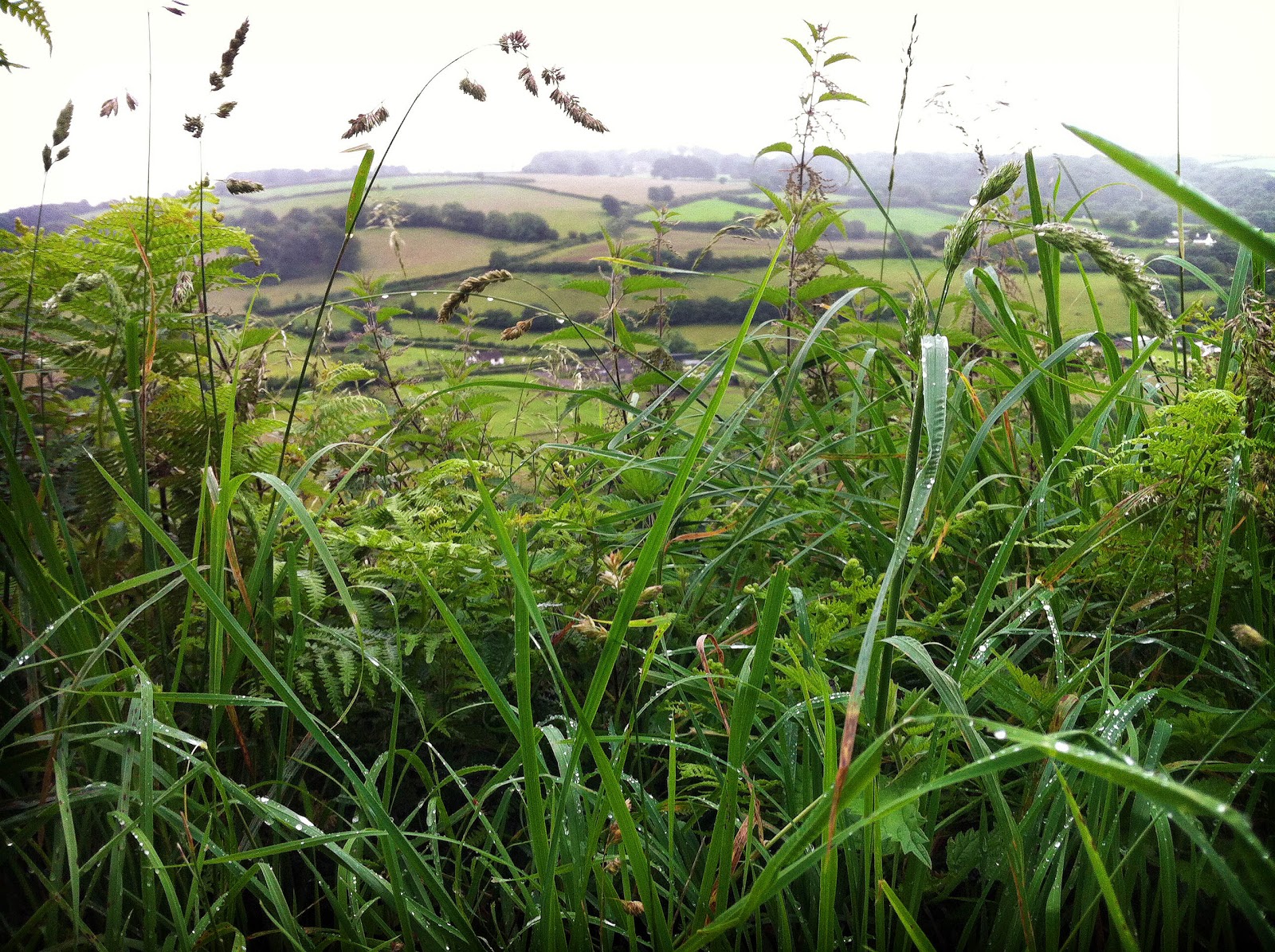
I was in Great Torrington, an old Cavalier town.  The pavements were glassy with rain and then the sun came out, and so did I.  As an old fortress town, Great Torrington is high up on a hill, so the beginning of any run is easy, quick and light (although I am fully aware of what will happen when my circle is complete and I will have to clamber back up the ramparts).  Nearby, there is a disused railway - one of the many casualties of the demon Dr Beeching’s cuts in the 60s. Now, the area is overgrown.  There is a narrow concrete path, but it is being besieged by the life of the embankments on both sides.  The maze of green is made of wild clematis, euphorbia, and hundreds of different grasses of such varied air.  Ferns, swaying elder, wild strawberries, clambering roses, and fingers of pollarded hazels all roll back to disappear into the darkness of a forest. The ground cover and the spears of grass pointing skyward look crosshatched. The River Torridge is in torrent from all the rain, making thick silken curls of muddy caramel by its banks. Darting goldfinches and copper-blue dragonflies zip to and from my vision.  I keep my shoes on because it is impossible to see what lies beneath the surface of the squelching earth.  And there is something very strange about the heat.  As I run past one of the low-lying fields it pulsates warmth.  Like it is exhaling  a long hot breath in the sunshine, the heat comes and it goes.  After the rains, the land is alive, the lilac bells of foxglove grow like hooks out of the hillside to catch the sunshine that they’ve not seen for weeks. And the thought hits me: it is not profound.  This is why I love late Monet.  He does this. He ‘gets’ this. 
John Fowles, in his wonderful paean to The Tree, explained why he so despised Linnaeus. He thought that the system of classification took a chisel to the world and divided it (there is a wonderful Borges skit about taxonomy, too).  He thought that damage was done to nature in the act of naming, of separating things from one another, and failing to see the tender skeins of connection that lie between.
Hardy explains in The Woodlanders “In her present beholder's mind the scene formed by the girlish spar-maker composed itself into a post-Raffaelite picture of extremest quality, wherein the girl's hair alone, as the focus of observation, was depicted with intensity and distinctness, and her face, shoulders, hands, and figure in general, being a blurred mass of unimportant detail lost in haze and obscurity.” Hardy here is trying to achieve the same effect: one of impressionism.  Unlike John Everett Millais’ Ophelia where every blade of grass is lovingly recorded, Monet and Hardy are interested in the links between the things.  Look again at the Millais painting and you will see that although Ophelia first appears to be in nature, not a single leaf of grass or flower is touching her - she is quite separate from her surroundings. Monet’s late work was a response to this form of representation - unlike Canaletto who wished to the world atomistically, Monet bounds headlong at the canvas to record its connections because nature itself is sublime, and unrecordable.  In a diary entry Hardy recorded this: 'Nature', he wrote in December 1885, 'is an arch-dissembler... nothing is as it appears.' 
How can it be? There is only ever impression and connection. It’s why I run.


Great Torrington - overlooking the Torridge vale