Sunday, 17 July 2011

Wormholes - Running Through Space-Time


Footfalls echo in the memory
Down the passage which we did not take
Towards the door we never opened
(‘Burnt Norton’ - T. S. Eliot)

One of the greatest pleasures of being able to run is your ability to experience space.  Space in motion, shifting perspective, the same, but always different.  If you are going to do 11 miles on a particular day, the limitations or the entrapment of having-to-do-11-miles enacts for you a kind of wonderful freedom.  At mile three today, I turned a corner and right by me was a passageway that I had never seen before.  A wormhole.  I still had 8 miles to do.  I could turn in any direction I liked.  The new pathway could take me anywhere.  It would not matter where.  I could run it for 4 miles and if I was lost, easily retrace my steps back.  I had strayed a couple of metres past it, but I was already within the event horizon, so turned sharply and entered the passage.  In my head was John Barry’s haunting waltz, the soaring and tumbling score to The Black Hole (listen to it here – and turn it up as loud as you dare).  This little turn took me to the thirteenth century, to hanged highwaymen, to the French Revolution, and to another kind of bustling vortex, and all because I decided to go right, instead of straight on. 
Wormholes are are a kind of speculative or hypothetical offspring from the coupling of topology (the metaphysical study of place) and astrophysics.  Much like the inability of the inhabitants of Abbott’s Lineland to conceive of two- or three-dimensionsonal space, so with wormholes.  We are stranded in our four dimensions, with its superstructure of metaphors and syntaxes built entirely to make sense of those parameters, not to describe what may lie beyond them.   In its simplest terms, we might think of them as two black holes joined by a spinning blend of the laws of physics that as yet are not understood.  Think of water swirling down a plughole, now imagine that at the other end of that pipe is not an outlet but another swirling plughole that seems to be sending water back up towards you.  What happens between the vortices? 
Strange things.
I have done this before, seen a passageway, turned and explored it.  The effect is uncanny, much more so than one might imagine.  You leave one part of London, follow a trail and find yourself in quite another.  The feeling is certainly accentuated by the act of running because one’s experience of space happens, well, faster.  A few miles into a run you are also more susceptible to any form of hypnotic ecstasy, or psycho-spatial displacement.  The slow parabolas of London’s miniature avenues and passageways, and the fact that they are housed and tree-lined, make it difficult for the runner to keep a firm sense of direction.  Moreover, when the visual clues of sunlight, or exposed trees that bend towards the north-east (trampled upon by the prevailing wind), without puddles (which sometimes help to reveal north), or the lopsided foliage-growth of a tree (which sometimes helps to reveal south), when these things are gone, and you have been running the passage for a mile or so, you could be anywhere.  ‘Anywhere within a mile’ you might reasonably argue.  Well, no actually.  There is a corner that I turn on a quiet road in south-east Blackheath.  On a satellite map I am a couple of hundred foot away from Kidbrooke (what a beautiful name for a place).  I could vault a few fences, dodge some guard dogs, climb a tree or two and I would be there.  I am not going to do this.  If I wanted to get to Kidbrooke it would be at least a two mile walk between those two practically adjacent points on the map.  Our experience of the space around us is not purely two-dimensional because all sorts of legal boundaries circumscribe it.  In such circumstances, it is much closer to one-dimensional travel, a maze of interconnected tubes.  So if you find a wormhole, it could take you somewhere you did not imagine possible.  I do not mean Costa Rica, more like a completely different part of Southwark you could not have believed was so close. 
It has happened to me before.  A run from Lewisham, through Ladywell (a terrible name, but still not as bad as Mudchute), I took a turn, headed into some streets - pop, Catford Gyratory.   
What about that fourth dimension? ‘That which hath been is now;‘ (Ecclesiastes 3:15).  My wormhole today brought me out in a suburban sprawl.   Once out of the passage, the sun in the sky was clear and I could easily read my heading if I needed to turn back. I still had a couple of miles to borrow from the bank so I persevered.  Masses of twentieth-century housing, bright red brick, white panelling, tower blocks, scruffy veterinary practices, and ‘that roar’.  That roar could only be the A2, the main road between Kent and London (the one that Bond chases Auric Goldfinger on in Fleming’s 1958 novel, Goldfinger), and it was getting louder.  I couldn’t see it but it was close.  The few children I had passed had all disappeared here.  All was still, forced indoors by rage and carbon monoxide.  Then, escape.  There is a footbridge.  I drive on this stretch of road a hundred times a year, or more, and I have seen it from two vantage points: heading east, heading west.  Today from on high I get to see it stretch for miles in either direction.  The Shard, still unfinished, is evidence of London’s creep ever higher to dominate the view for miles around.
The sound is astonishing.  How and why do people live here.  The houses are in good condition.  This is no suburban shanty-town (like where I live), and this road out to Kent has been here long before any of these houses.  I am not thinking this, of course, as I trample along, trapped into having to run parallel to the road, but I know that escape is coming soon.  To get back on to ‘my‘ land I need to cross a roundabout.  It is a roundabout that has interested me ever since the first time that I used it.  It is a big roundabout with a circumference of several hundred metres, and I have never been anywhere near it on foot before so I am surprised to see that there is a pedestrian subway.  
This is Shooter’s Hill.   
I first heard of it many years ago when I was reading A Tale of Two Cities.  The dramatic beginning of the novel, set in the eighteenth-century, has a mail coach lumbering up Shooter’s Hill on a dark and stormy night, and it is being chased by a man horseback.  The passengers well know why it is called ‘Shooter’s Hill’, because it belongs to the highwaymen.  But it was already called Shooter’s Hill, long before the daring Turpins of the eighteenth century.  The name is first recorded in 1226, having acquired it at some point before then - so presumably roadside robberies have been a tradition here for over a millennium.  
I run down the ramp and find myself at the still centre of a roaring vortex of traffic travelling north, south, east and west.  Any direction and any destination is possible from here.  It is a concrete crucible with beds of flowering lavender, but who could possibly come here to piss?  Many it seems, for it crowds out everything else.
Time folds here, slowly, like layers of chalk.  Some tagster has sprayed ‘PEST’ on a wall so clean and white that it must hide numerous strata of these urban signatures.  For me, there is the memory of irony; of being stuck here in a traffic jam for nearly three hours, late for my very first lecture of the previous year.  A lecture on time, history and A Tale of Two Cities.  The confluence of geography and circumstance few would sanely believe: jammed at precisely the spot where the novel begins. 
Time folds again and it takes us from Dickens’s writing of the novel in 1859, to its setting in the 1790s.  This was the Dover Road - the mainline in and out of revolutionary France.  
Again the strata of memory folds backwards and the hanged highwaymen are here.  Strung up in the eighteenth century and before to deter robberies, when surely the effect must have been to terrify the passengers on the mail coach.
Deeper and we can see the marauders hidden amongst the trees of the dark ages that must first have given this place such a name.
It folds forwards, too, to the very beginnings of the internal combustion engine.  The earliest cars were tried out here.  Alexander Gordon in A Treatise Upon Elemental Locomotion and Interior Communication (1834) recalls, ‘In 1826, Mr Samuel Brown applied his gas-vacuum engine to a carriage, and ascended Shooter’s-hill to the satisfaction of numerous spectators.  The great expense, however, which attended the working of a gas-vacuum engine, prevented its adoption.’
Oh no it didn’t, Mr Gordon - the internal combustion engine had to wait for the right time, but being here, there is a great deal of growling sensory evidence of its world domination.
Leaving via the opposite ramp, still on the A2, being out of the engine tunnel it already seemed quieter.
In a title to one of his best books, Stephen Jay Gould drew on a metaphor of time that he saw employed and deployed repeatedly in science for the last few hundred years.  The metaphors are Time’s Arrow, Time’s Cycle.   These places, wormholes, are imbued with stratigraphic layers of history and meaning.  The places are still there and so are the traces of what they have witnessed.  Our experience of space is circumscribed by social forces beyond our immediate control; they prevent our free movement within and around the landscape.  But if you look down through time, you will find that you are quite free, there.  Nothing prevents you from feeling the presence and weight of the past and the future.  All of it is there, and it is for all of us, all of the time. 
Time is not an arrow.  It is not a circle.  It does not loop neatly back like an oxbow and continue.  It is a corolla, endlessly looping away from the moment, thrown out of its trajectory, and endlessly, endlessly returning.  
Within a hundred metres I was back on ‘my own’ ground.  The place I had orbitted perhaps a thousand times in my car was now permanently defamiliarized by the memory of the few seconds I spent running through it.
Reading Hardy’s Mayor of Casterbridge later that day, I was struck by one of his narratorial comments. ‘Time, the magician, had wrought much change, here.’
There is an infinity of possibility and presence in the moment, exquisitely and deeply lived.

Tuesday, 12 July 2011

We Have Moved

This blog has now shuffled over to www.psychojography.blogspot.com where you will find new entries.

Thank you

Saturday, 9 July 2011

Gounod and the Death Star

      The sky was cool glass. A giant cloche had been placed over the world and only sunlight breathed into it, at least that was until I stepped onto Blackheath. There is always a breeze on Blackheath, no matter how hot or still the day the world never stands still up there. The roar of the pulmonary A2 is never far away, but it loses the fight for dominance amongst all this grass and sky. Caught at the right moment, you can get nearly all of it to yourself.
      I had set out that morning with a thin desire to go past Gounod’s house. ‘Go past’ is incorrect. I have been past it many times, this morning I intended to notice it for the first time. It is a Georgian villa tucked away in a suburb southeast of the heath. I run through the area quite frequently. It sits between the A2 and the South Circular and once you are there, you would never know that either road existed, or even that you were in the twenty-first century, barring a runes-throw of cars and streetlights. You can run in the centre of the road where there is no camber, do a mile and a half, snaking one’s way up to the heath and you will be disturbed by perhaps only one car. It will be so polite and quiet that you probably won’t need to move aside to let it pass. It is the interloper here, not you, for we are no longer in the twenty-first century.
Prince's Dock - Hull
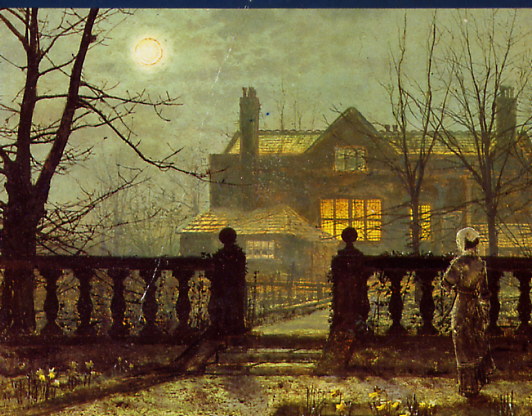
      The houses! There is little or no uniformity. Bomb damage from the war probably accounts for a number of the newer builds but altogether these houses look like they have mad wives locked up in them, or jewel thieves disguised as Lady’s maids awaiting the right moment to swipe, or illegitimate daughters planning to marry back their stolen inheritances. These houses belong to Wilkie Collins, Mary Braddon, Charles Reade, Dickens even, and they always remind me of Atkinson-Grimshaw paintings - perhaps because his work is so often used on their covers as classic editions. The paintings (and the houses) have a sub-Turneresque quality, with a clearer and more distinct line, and they are nonetheless decidedly odd. Turner could turn his hand to almost any visual language. He was a stylistic polyglot.   The Turner that we talk of when we say ‘Turner’ tends to be late Turner, the one that depicted snowstorms, hostile rainclouds, steam trains crashing through dense landscapes like raging bulls, all in barometric vortices of light, paint and colour. Atkinson-Grimshaw’s paintings are less emotionally ambitious but what is queer about them is their light and setting. The streetscapes that he would become well known for are always defamiliarized through colour. Docks, roadways, houses take on the hues of pond-slime brown, nicotine yellow, or that dirty emerald that became the pallette for Tretchikoff’s retro-trendy green lady that disturbed me from many a wall as a child. The paint always looks dirty. Horse and carriage tracks in which water has collected reflect the deadening glare and suggest life long gone. In the paintings there are always houses from which light spills from the windows onto a rain-soaked street. There is no life, though. The figures, sometimes none, often one, and occasionally many, have their backs turned to us or hide their faces. The houses are closed to them and us. The paintings tell us that we are merely the houses' observers. The lights are on, somebody is home, but not to us. Real life is elsewhere.
       There are greater parallels between Atkinson-Grimshaw and eastern Blackheath than you might imagine. Re-read the last couple of hundred words and they describe, with surprisingly few adjustments, what it is like to walk or run through this area at dusk. There are so many striking houses, windows so large they would not fit on any fascia of my flat. All that glass and no one to look out of it. No one ever tends a garden, washes their car, chats to a neighbour, hunches up their drive with a brace of Sainsbury’s bags. I have seen security that guard the entrances and exits to the road from undesired traffic, but never who or what it is that they are securing. I have run these streets probably over a hundred times, and never have I seen someone looking out of these windows. I wonder how different these houses are to the bourgeois fortresses in Victorian sensation fiction, places of confinement, where, like Laura Fairlie in The Woman in White, or Madame Bovary, one might find themselves suddenly and quietly buried alive.
In his day, Atkinson Grimshaw was criticised for endlessly recycling the same image, sometimes to order. Exercises in light and colour, his painting thrummed always in the same minor key. But for me it seems that his work represents something else altogether about bourgeois communities. In the paintings, the houses are always walled off from their onlookers. They seem to fight so fiercely for isolation and disconnection; to make-believe that they are not where they are, in central London, but elsewhere. Today we have alarms and fences keep the world out so that their owners can deny their place in the earth, so that they can pretend that their roots reach into some different ground?
       As Carlyle said, "Courage, dear reader, I see Land!"
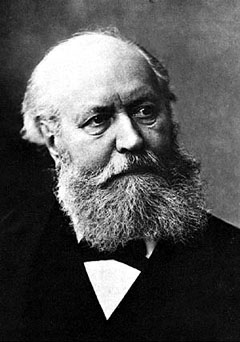
Charles Gounod
       Towards the northern end of this area is where Gounod stayed when he first came to London. Like the bourgeois characters in Maupassant's 'Boile de Suif' (which we will pop back to on our return – we’ll see how we are for time), Gounod came to London to flee the Franco-Prussian War, and found himself embroiled in a wicked plot that Collins or Braddon would have been embarrassed to use. For those interested, it is on Morden Road (it was '8', but is now '15') and it is the house that he stayed in after arriving here, before he and his wife moved in with Georgina Weldon at Tavistock House (demolished) in Bloomsbury Square. Their relationship was probably a platonic one. They knew each other through the opera (Weldon was a celebrated soprano). A decade previously she had married William Henry Weldon and was consequently disinherited by her father. Her husband, though – like her father, refused to allow her to follow a career on stage and she was limited to amateur theatricals and charity concerts. The couple had no children, and by the time she met Gounod, the marriage was failing. Bored and frustrated Weldon (Georgina) set up a school for orphans and the children of the ‘deserving’ poor. After she persuaded Gounod to move in with her and her husband the two became very close. He was impressed with her vocal talent and he promised her the title role in his opera Polyeucte which he was writing during his stay with them. No one knows why Gounod left Tavistock House when he did, but when he returned to Paris Weldon refused to send on his belongings – including the first draft of Polyeucte.
Georgina Weldon
       The Weldons’ marriage continued to limp onwards. In 1875 they separated but after only 3 years Harry tired of the annual £1000 that he had agreed to settle on her, so he tried to use her interest in spiritualism to prove her insane. If proven, she would have been locked away in an asylum. She was duped into being assessed, forms were signed and they came to take her away. Realising, at last, what her husband’s plan was she escaped and went on the run. The state of Victorian civil law meant that she was unable to bring a case against her husband so she decided instead to publicise her story. She could get into court if her husband tried to sue her for libel. They didn’t. The law eventually caught up with her. The Married Women’s Property Act of 1882 permitted her the freedom to bring a case against her husband. She won. For the next six years she was in and out of court constantly bringing all of those involved in the Weldon Affair to justice. At one point, she had 17 cases going at once and in all of these refused counsel. Her character as a wronged woman, so clean that she was used in a Pears Soap advertisement.
       One of the major attacks on the sensation fiction of the nineteenth century, the ones that use the Atkinson-Grimshaw images as covers, was that they were too far-fetched. In the Weldon Affair, via The Woman in White, art had become life.
       Blackheath at last – where a man scowled at me for looking at his kite.
I had another 5 or so miles to do of the run so headed across the heath to the park. Making my way down towards Greenwich I was struck by another view, and the first thought that sprung to my mind was 'How nice to be here and not there, today.'
From the exact point in the Park
       From the fortresses of the past, to one of the future. As you approach from south, the ground falls away from you quite suddenly and there is a view so specific that it looks to have been carved out of the park. It is One Canada Square, or Canary Wharf as it is more commonly known. It is one of those views that appears as if through a magnifying lens. It looks much closer than it is, than it can possibly be. The whole scene is like some anachronistic vision of Humphrey Repton. A carefully organized park and woodland from which to view...? Canary Whart. At the Greenwich Observatory tourists crowd around to photograph and record this vision of mediocrity. Steel and concrete blocks built to house London's manufacturing (sorry, I couldn't resist) nothingness industry that the country pays billions and billions to preserve. Most of these buildings are characterless, but Canary Whart does belong here. Just like Henrietta Stackpole in James' The Portrait of a Lady, it has the stench of the future. From a distance it looks like a prison from science fiction. There ought to be guards hovering ouside the tower wearing jet packs. If London were in Star Wars this would be the Death Star.
       It is not from the future, though - if only it was. Instead, it hails from the 80s; it is firm, robust, solid, shiny. If architecture could be haute-couture this would be its shoulder-pads. True to its toughened pretensions, it thinks rather highly of itself. The tower's point has a blinking searchlight, either keeping an eye on us mere mortals who dare to look upon it, or ensuring that it can announce its mediocre height in the dark, too. It is not the tallest building in the world, it is not the tallest building in Europe, it is not the tallest building in the UK, it is not even the tallest building in London. Yet it still had the temerity to evacuate on September 11th, like this steely Whart could see itself as a target in the same league as the Pentagon and the Twin Towers. Such a move committed a grave and self-aggrandizing disservice to the memory of hundreds that died that day. The evacuation of the building shuffled for elbowroom that it did not deserve on that day’s overcrowded newsreels.
       My run was nearly done. I was in the final mile (of 9, I think it was). By the duck pond in Manor Park (shhh... it's a secret) there is a sturdy iron fence, with a small gate, about shoulder high. As I approached children, fathers, mothers, and their fathers and mothers, all simultaneously appeared, like traffic in The Truman Show, from both sides wanting in- and egress. They were pigeons having eyed a discarded bread roll. I had come too far; I wasn't going to stop and patiently wait my turn. Without breaking pace, and well out of the way, I leapt and levered myself over the railings, barely touching them. A kid said 'cool!' Was that pride I felt, just briefly, to be told 'cool' by such a little stranger as I ran off.
       Vanitas vanitatum.
       I wonder if it was at that moment, landing too hard on my ankle, that I gave myself the minor sprain which I have been tending to ever since.

(Sorry, Maupassant’s Lard Ball will have to wait for another time.)

Sunday, 3 July 2011

Going Back - with Mr Carlyle and Mr Lawrence

Going back is amongst the most difficult things for a runner to do.  The momentum that they build up over their weeks, months, or years of training is their greatest weakness.  Ignoring obstacles, or even the possibility of their existence, the runner's propulsion drives them onwards towards a real or imagined finish line.  Once fixated upon it, it may as well have been engraved in the granite in their minds if you try to convince them to cut back or be more realistic with their expectations.  You roll the dice; you get injured and find that you have not landed on a ladder, but a long and slithering snake. You can slide down back to the shallows, or in anger you can toss the board aside and forget your disappointment with some other, less fulfilling, activity.
Recovering ground is difficult on so many levels. You are not only forced to acknowledge that you are suffering the indignity of sliding down a snake, there is also the promised boredom of revisiting the same milestones during your training on the slow climb back up.  This second, third, or eighth journey shows you a familiar, but there is a shadow upon it.  This time round you feel fear.  You know that as you crawl back (months later) to where you were, that this was your limit - your absolute limit.  This is the point where the whole miserable fucking process is likely to begin again.  You set out in trepidation and await the verdict.
On the 6th March 1835, the philosopher, John Stuart Mill with some trepidation knocked at the door of his friend Thomas Carlyle.  The door opened to reveal an agitated and distraught Mill.  He had with him four charred pages. This was all that was left of Carlyle’s first handwritten manuscript of the epic and poetic history of The French Revolution that he had lent to Mill to read - although it was only the first volume this still amounted to about 100,000 words.  The maid had mistaken the pages for waste paper and thrown the lot on the fire. Both Thomas and his wife Jane peered over the brink of nervous collapse.  Mill was forgiven even though the loss was seemingly irrecoverable and Carlyle set to work on the second volume of the history.  He completed it a year later in March 1836, going back to the first volume anew.  He finished at 10pm on 12th January 1837, he wrote ‘ready both to weep and to pray’. The French Revolution was an enduring success, loved and loathed by many to date.  Carlyle’s career continued apace.
Despite his reputation today, D. H. Lawrence was not particularly well known or widely respected in his own lifetime, not that is until the publication of Lady Chatterley’s Lover in 1928.  Up until then, novels like Sons and Lovers, The Rainbow and Women in Love were read by relatively few (very few in the case of The Rainbow).  Despite continuous and pressing financial worries that plagued him, Lawrence never published anything until he was satisfied with it.  This is not a writer who wants to check for typos and plot points – not an easily distracted worker, like Shakespeare.  Throughout his career Lawrence always demonstrated an astonishing determination not to let go of a novel until he was sure that it was right.  No, not 'right', perfect.  Lady Chatterley’s Lover exists in three separate and complete versions (all quite different), but it was the third that Lawrence published in Florence to avoid the insulting strictures of censorship that his earlier work had encountered in Britain (his publisher's offices had been raided for copies of The Rainbow).  Sons and Lovers was written no less than four times, originally entitled Paul Morel.  The stamina, determination and commitment to an artistic vision that we see in Lawrence are things witnessed surely less than once in any generation.
Both men, in their different ways, demonstrate a kind of doggedness in their ability to go back to the beginning and start again.  This ability amazes me.  I will let you into a secret, I am here, and I am doing this.  You know I am; look, you can see me doing it.  I should actually be working on a 100,000-word manuscript that I have already written.  All I need to do is to get my head down and correct it, titivate it, rewrite a few bits of it so it can go back to the academic press so they might publish it.  I can apply for promotion, I can move on to another project.  I would never have to think about, or explain, The Epic of Gilgamesh ever again.  What I should actually be doing right now is going back. I just can't.
Have you heard of the 1867 novel The Poor Man and the Lady?  It is a ‘striking socialist novel’; at least that is what Hardy called it in his self-penned biography (not autobiography, it is published under his second wife’s name). That is almost all we know about it.  Only a handful of people have read it: Hardy’s friend and mentor, Horace Moule (who thought it rather coarse), and a handful of publishers all of whom rejected it.  The book was put away, forgotten about, eventually to be burned. But out of the ashes of The Poor Man and the Lady an entire career was born.  Once the novel was put aside, Hardy set to work on a much more market-friendly sensation novel begun in 1869, published two years later (Desperate Remedies).  This was not the right kind of work for Hardy; he had not yet worked out how to knit melodrama and realism in the subtle manner that he would in novels like The Mayor of Casterbridge, or Tess of the D'Urbevilles.  Next to be published was Under the Greenwood Tree (1872).  This is a slender and lightly comic novel with a rural setting that shows Hardy’s roots as a novelist reaching deep into the earth of his upbringing in the West Country.  The first paragraph is instantly recognisable as a mature Hardy's first steps.
To dwellers in a wood almost every species of tree has its voice as well as its feature. At the passing of the breeze the fir-trees sob and moan no less distinctly than they rock; the holly whistles as it battles with itself; the ash hisses amid its quiverings; the beech rustles while its flat boughs rise and fall.
A phoenix did not rise from the ashes of The Poor Man and the Lady; it was an entire writer’s career.  His life as a novelist was begun.  The Poor Man and the Lady reached forward in time, remnants of it are found in Hardy’s poetry, and it was worked into a novella ‘An Indiscretion in the Life of an Heiress’; it also became the source for his most infamous novel, Jude the Obscure.  This fact is not to be underestimated in the context of his career as a writer.  It is often heard around people that do not know much about Hardy that Jude was his last novel, and he was so incensed by the critical response to it that out of pique he refused to write another.  Neither assumption is true. The Well-Beloved, which had started its life as a short serial in 1892 was completely reworked and published as a novel two years after Jude in 1897. Also, Jude was, by far, Hardy’s greatest financial success. He became a monied and a lettered man and for the first time in his life was free to choose what he might do.  He had always wanted to be a poet, and that is just what he became.  The Poor Man and the Lady became Jude, and Jude was what enabled Hardy the novelist to become Hardy the poet.  In refusing to go back, Hardy's career drew its structure from his 'failure'.  Had his first novel not been consumed by the flames, then he may not have felt the need to revisit the themes of injustice and class inequality that became the mainstay of his long and productive writing life.
Going back, turning back and admitting defeat, that you cannot finish your planned route, that you have to stop your training, retrace your footsteps home, to Rest, Ice, Compression and Elevation – surely the four ugliest and least-poetic words in any language - you feel like Sisyphus letting go of the boulder at the top of the hill only to watch it tumble all the way back down.
You could just do it all again, like Carlyle, and you may find that next time you make it, but to what?  That mileage that you did not achieve last time?  Then what?  More mileage until you injure yourself?  Your injury emerged out of your behaviour and your physiology, if neither of these things change, why would you believe that the outcome would be significantly different to the first time round?  If you are like Lawrence, you will do it again and again until you get it right.  I tried this for most of my adult life, though I found that I do not have an ounce of the stamina that he did.
Scar tissue heals most weakly.  It repairs quickly, like physiological superglue, and it lies brittly in wait for the next strains of tension so that they can tear. (That sentence works just as well with 'psychological' in the middle of it).  Dogged determination is all very well if you have both superhuman stamina and strength to keep you going.  Few do.
Hesitating to use the metaphor in a blog so clearly about the love of the natural world, you could instead recycle the experience.  Like Hardy, you could put away that particular game and do something else.  Same genre, different form.
If running that way has not worked for you then do not stop.  Recycle your knowledge and experience and use that momentum to prepare yourself for something new.  Just try doing it a little differently. Who knows, you may even try taking your shoes off...


Monday, 27 June 2011

Wilde Times on the Treadmill

    My third run this week in the rain.  Any sensible person would ask, why don't you just go to the gym?  
    As a troubled child John Clare set out one morning to walk to the horizon.  But the horizon, the imagined and perfect coign of vantage from which to survey the earth is an illusion of perspective.  A point created only by the observer.  It is not the end of nature; it is the end of our ability to perceive it.  Clare later wrote 'I long for scenes where man has never trod ... There to abide... and sleep as I in childhood sweetly slept: untroubling and untroubled where I lie; the grass below - above, the vaulted sky.'  In these lines there is a longing for a return to the earth, to childhood, or even to the grave.  The lines turn upon the interpretation of ‘untroubling’.  Is Clare saying that ‘where I wish to lie will be a place that provides undisturbed and peaceful rest’? Or, is it, ‘where I wish to lie shall be undisturbed by my presence’?  What is so great about Clare’s poetry at its best (like in ‘I Am’ or ‘The Badger’) is that such double meanings in themselves create a sense of doubt about our relationship with the natural world.  On the one hand, Romantic poets like Wordsworth on first seeing Mont Blanc grieve, as he says in The Prelude, ‘to have a soulless image on the eye’ when the idea of nature is usurped by the sight of its actuality.  The potential of ‘man’s’ imaginative power, offended by the paucity of nature’s finest offering.  On the other, Clare suggests that he does not watch nature; he is of it.  His arrival at his place of rest would be ‘untroubling’ to his surroundings and harmonious with it.  If a tree falls in the woods and there was nobody there to hear it, does it make any sound?  Wordsworth would reply ‘If there is nobody there to hear it, then who cares?’  Clare, silent, would mourn the loss of it.  I love Wordsworth, more than most poets, but I am with Clare.  Our existence is a creaturely one.  What does this have to do with going to the gym?
    For most of the eighteenth and nineteenth centuries, prisoners of Her Majesty who had been sentenced to ‘hard labour’ worked (yes, wait for it) a treadmill.  The treadmill was for nearly 200 years the harshest punishment (beyond the death sentence) that a judge could condemn the prisoner to.
    Oscar Wilde was one of the Act's condemnees, prosecuted for gross indecency under the Labouchere Amendment of 1885.  In his biography, Richard Ellman explains that during Wilde's time in Pentonville prison he had to walk the treadmill for around six hours a day.  The prison’s chaplain wrote,
'When he first came down here […] he was in an excited flurried condition, and seemed as if he wished to face his punishment without flinching. But all this has passed away. As soon as the excitement aroused by the trial subsided and he had to encounter the daily routine of prison life his fortitude began to give way and rapidly collapsed altogether. He is now quite crushed and broken. This is unfortunate, as a prisoner who breaks down in one direction generally breaks down in several, and I fear from what I hear and see that perverse sexual practices are again getting the mastery over him. This is a common occurrence among prisoners of his class and is of course favoured by constant cellular isolation. The odour of his cell is now so bad that the officer in charge of him has to use carbolic acid in it every day […].  I need hardly tell you that he is a man of decidedly morbid disposition [...] In fact some of our most experienced officers openly say that they don't think he will be able to go through the two years.'
He did make it through, but only just; he died in exile and infamy only a couple of years after his release.
    Times have changed.  Treadmills used to be a tool of punishment but we now pay private-school-fee levels of gym membership for the honour of running on them.  People will tell you that there is nothing worse than an ex-smoker.  There are: I am an ex-smoking, ex-gym user.  Don’t get me wrong, I was never terribly committed  to either pursuit, but I used to go to the gym because I played squash and badminton and a bit of gym was good for the elastic body.  But I nearly always ran outside, even when I was paying £85 a month to run inside.  For me, then and now, it is still too close to a punishment.  Every machine is aimed like a crossbow to a target at a TV screen.  Lines of TVs tuned to different channels.  The tinny headphones that you have to turn up ridiculously loud just to hear the news telling you 'What we need is a patient-centred NHS.'  The whole point, I know it's a cliché, but the whole point of running is to get away from all this, well, rubbish:  Cables, Screens, Soundbites, Machines, Double-glazing, Giant bouncy balls, Floor-to-ceiling mirrors, Techno, Tacksuits (sic), Abs, and the noise.  The noise that not only you and your machine make, but the noise that everyone else makes with their clanging weights, huffing, puffing, yowling, whirring, stamping, shoooooosh!ing – all can be heard on any visit to this foul supermarket of stretching and sweat. (More serene runs are to be had on the Catford Gyratory.)  Like brains in vats, their headphone cables are spinal cords plugged into the global Sky News network.  They are dead and Skynet lives. 
   Here, you are not a person, you are a consumer, but not one with choice.  You are a foie-gras goose to be speed-stuffed with meaningless and empty experience none of which you will ever remember.  Wordsworth and Thomas De Quincey, two figures who repeatedly delighted in the profoundly productive and fructifying powers of memory, would have taken a hammer to your knees had they seen you running on them.  A run on a treadmill has all the philosophical significance of brushing your teeth (you may remember doing it today, but what about twelve days ago?)  I have done countless runs in the last 6 months that I will remember to the end of my days.  I do not have a particularly well-developed memory - I can never remember Michael Gambon's name whenever I need it (consider yourself honoured, dear reader, you have just witnessed a rare thing indeed).  I can remember bus loads about my runs, even regular ones from months ago: running on Blackheath in a blizzard; my first barefoot run round Lewisham; running up what felt like a vertical cliff to the Tennyson monument near Freshwater on the Isle of Wight (on two separate occasions); another barefooter at Seasalter in Kent - a beautifully stressed post-apocalyptic piece of coastline where the staff in a deserted pub gave me a free bag of crisps because I had missed lunch.  There are many more, but the point is that all of these runs brought me something, meant something, and continue to mean something.
    In the case of the latter, I had no foreknowledge of the Seasalter landscape so began the run shod, then dumped my shoes on the footpath after about half a mile to be collected on the way back.  The ground was hard and dry, but softened by a cool and pert furring of grass.  It was bliss to run on.  There were a few kissing gates that had waist-high nettles growing in them, so I climbed onto the concrete sea barrier and went round them instead.  Just about the only person I saw on the run was after I had done my miles for the day and was returning to collect my shoes.  The chap was a bit older than me (the age of a shopkeeper from your childhood, say).  He looked at my ridiculous shoes nestled in the ankle-high grass, one fire-engine red and one custard-yellow.  Leaning over to get a closer look, like that would help, he looked as if he had been a dog he would have barked at them.  He glanced up and saw me a good many yards off.  His gaze dropped to my shoelessness and, 'ah', all was explained.  He began to move on and gave me a polite smile as I passed him.  I finished up by doing some light speed-work with five repetitions that declined in speed. 
Aren't they a riot?
    This run was months ago and I have not scratched the surface of all the things I remember about it.  I remember the weather (crisp sun and a light breeze); the serious-looking, fat, topless man on the white bike who did not look at me as we crossed paths; the bright orange lichen which clung to the sea wall, the milky-coffee sea, you get the idea.  It may sound like it was, but it was not a particularly special run, or a memorable one.  One thing it was, though: it was a real and lived experience.  In my life I have run on treadmills many times.  I recall nothing specific about any of those experiences.  Nothing.  Nothing.  If Kennedy had been shot while I was running on a treadmill I would not be able to say where I was when I heard the news.
    Treadmills are dehumanising.  They are the most abject and useless forms of punishment that eighteenth-century penal philosophers could devise.  The 1779 Penitentiary Act stated that prisoners should endure ‘labour of the hardest and most servile kind in which drudgery is chiefly required and where the work is little liable to be spoiled by ignorance, neglect, or obstinacy’.  Think about that next time you may want to step onto a treadmill, ‘this machine’s guiding purpose is to instill in me feelings of  ‘drudgery’.’  Surely there is enough of that in modern life to see you through already.  Treadmills turn us into automata.  Everything that a run might be, everything that puts us in touch with our creaturely life on this earth is taken away from us on a treadmill.  John Gray in Straw Dogs: Thoughts on Humans and Other Animals posits an answer to the biggest question of all: what is the purpose of our lives? ‘Other animals do not need a purpose in life.  A contradiction in itself, the human animal cannot do without one.  Can we not think of the aim of life being simply to see?’  There is nothing to witness on a treadmill.  It denies us our creaturely existence.  Look at the picture below.  Does it say 'freedom' to you?

    In the nineteenth century the design of the prisoners’ treadmill changed slightly with the installation of panels to separate the prisoners so that they could not talk to one another, that they might contemplate their crimes in isolation, and without distraction.  Now, if we go back to thinking about those treadmills aimed at the TV screens and the ‘free’ headphones that you are supplied with, what is actually going on?  Are you quite innocently being provided with a bit of entertainment for your run, or is something else happening.  The sociologist Erving Goffman in The Presentation of Self in Everyday Life asks why it is that when we are walking down the street and we glance at someone, they meet our eyes, and we immediately avert our gaze.  He suggests the reason we look away with such rapidity is that we all want to be complicit in creating an illusion: when we are in public we pretend that we are in private.  As a species we are not used to living in cities (we have only been doing it for a flint’s scratchy flash of our history).  Neither, it seems, are we particularly attuned to being in places where we do not know others.  Treadmills, and their organisation in gyms, have exactly the same effect as the separator panels did for the prisoners.  In a gym you ought not catch the eye of someone, their glance back will be loaded with the question ‘What the hell are you looking at me for, you should be looking at the TVs.’  There is not a chance that you might engage someone in conversation.  What would be the point?  You are wearing headphones and so are they.  Gyms are public places, they have to be to make money, but they desperately want us to feel like we are in private.
    I am not saying that you should talk to the person on the treadmill next to you.  I guarantee they won’t want to talk to you.  The etiquette is identical to the rules of social engagement at men’s urinals: eyes forward, concentrated silence, no talking, no farting, always choose the vacant space farthest away from the one that is occupied.  What I am saying that you should not get on one of these things in the first place.  And, what is so wrong with silence?  Even the hard-labour prisoners of the eighteenth and nineteenth centuries were permitted to think while they worked their mills.  Our gantry of TVs simultaneously tuned to Sky Sports 1, Sky Sports 2, Sky News, Eastenders, and Springwatch Live (if only!) make thinking impossible.  (Excuse me while I use a little Althusser), these places interpellate us into being timorous idiots that have to be coaxed away from the horrible and endless abysses of self-reflection that may be induced by a minute's silence.  If we are not goose-fed Technicolor images and ever-competing babble we might lose our minds as the full Sisyphusian futility of our lives become plain to us, we might lick the digital display, head-butt a TV screen, hang ourselves on the cabling, attempt to drown ourselves in the piddling drinking fountain, take-out one of those giant bouncy-ball trees, or ... we actually might like it.  The gyms should be honest and put up a sign: 'We ask customers to refrain from thinking in the exercise area, otherwise you just might realise how crap this experience really is.'  If you want to run on a treadmill then of course you should, but you should understand what it is that you're doing because I am not at all sure that I do.

We banged the tins, and bawled the hymns
And sweated on the mill,
But in the heart of every man
Terror was lying still.

                                                            Wilde – from The Ballad of Reading Gaol


Saturday, 25 June 2011

Most runners are desperately unkind...

I've just come in from a very wet 6 mile, zero-drop run (that means in 'barefoot' shoes, more on this later) and how many runners did I see out on Blackheath and in Greenwich Park throughout the entirety of the run? It was lunchtime, midweek, and it's mid-June (the solstice, if I'm not mistaken).  The answer is two.  Oh no, wait, he's running for a bus.  It was actually one person - and he didn't look too happy in his leggings, tent-flapping shorts, and mushroom-hunched manner. 
   What's going on?  In January, in freezing, dark, glum, January, the Park and the Heath were thronging (I don't actually know what that means - it's like 'rack and ruin', what on earth does 'rack' mean? Or chit-chat, 'chit', anyone?).  But they were thronging. Runners criss-crossed on the pathways like the choreographed beauties in a Busby Berkeley.  It was of course the interminable rain that was keeping some away. (I should have known better than to go out running so near to Glastonbury weekend, the annual signal to the nation that rain is on its way.)  It's not just the rain, though; so many of those January runners have gone.  Given up, some never to return.  Why so many?
   Most runners are unconscionably unkind to themselves.  And, the beginners are the most brutish in their behaviour.  Not for one moment would they countenance condemning their friends to the pain, occasional anguish, and punishment that they are forced to endure.  Oh no, sorry, that they force 'themselves' to endure.  That's the point.  They are downright mean to the unfit version of themselves, and unfortunately, that is the version of themselves that has turned up for those early 'runs'.  Not nice, quiet, jogs to get the heart, lungs and muscles warmed up, but 'runs'.  If they have allowed themselves to get so unfit, then they tell themselves they deserve this - it is only difficult for them because they haven't been exercising.  'So! I'll show you, body!'  In the blink of an eye their body becomes their enemy and they are at war.  Beginner runners wouldn't treat their enemies the way that they treat themselves on their first runs.  
   
   1.  Go slow - slower than you think.  No, slower than that.
Poetry is not very helpful, here.  Poetry tells us 'now', the novel tells us 'later'.  Think of Andrew Marvell's 'To His Coy Mistress', Robert Herrick's 'Gather ye Rosebuds' (from 'To the Virgins, to make much of Time'), or indeed most Metaphysical poetry, or of Auden's 'As I Walked Out One Evening' when 'all the clocks in the city/ Began to whirr and chime: "Oh let not Time deceive you, You cannot conquer Time"'.  The wonderful centrifugal effect of 'whirr' whips up a sense of the chaotic  rapidity of time spinning out of control, unravelling like an unattended reel of film.  Lyric poetry always wants us to rush, it seems.  Nibble-size literature to go.  
   The novel, though - that's a different matter.  The novel, all too often is happy to teach us to go slower than we want to.  Novels are littered with failed sprinters who just aren't up to the task.  Uriah Heep comes a cropper in his bid to gain control over poor Wickfield and his business in Dickens' David Copperfield.  Mrs Thornton from Elizabeth Gaskell's deliciously clever North and South is a more complex and certainly less comic version of what can go wrong when one leaps from one class to another.  Jane Austen's Sense and Sensibility is generous enough a novel to show us both sprinter and runner.  Two sisters, Elinor and Marianne, both lured to love by maybe the wrong, maybe the right, man.  Marianne professes her love privately, publicly, loudly and quickly and is crushed to discover her darling Willoughby has shagged and binned other women, and is promised instead to a woman whose charms are somewhat slighter than the contents of her purse.  Steady Elinor keeps her 'esteem' for boring Edward as secret as she can, does not change her mind, and is finally rewarded with marriage.  Too-fast Marianne has to be dragged and dangled over death's abyss by a love-induced fever to learn her lesson: to shut up a bit, and slow down.  She does, marries someone old, boring and virtually unsexed and is therefore 'happy' in Austen's world.  
Vanity Fair's Becky Sharp is about the only go-fast heroine I can think of that gets what she wants.  But even louche Thackeray could not countenance Becky as a heroine.  In case we too swiftly admire her adept social mountaineering we soon see her beating her child.  And, in case we are still in any doubt, Thackeray drew an illustration of her and subtitled it 'Becky's second appearance in the character of Clytemnestra'.  Having earlier played the role for Lord Steyne.  Joss (Agamemnon), her husband, dies offstage and the companies insuring him reluctantly pay, making it known that it was 'the blackest case' ever.
   Even in its form, the long and ponderous novel is one that can teach is to go slow.  If you go at it too fast, you'll run out of puff.  First attempts at War and Peace, Moby Dick, Underworld, Romola, all for me fell at the second hurdle because the first was approached too fast. Sprint off too quickly and you just won't make it.  Why do we always want to go so fast?  What for?

   2. Think of how much you'd like to do.  Then, think how much it might be wise to do.  Then, quarter it.
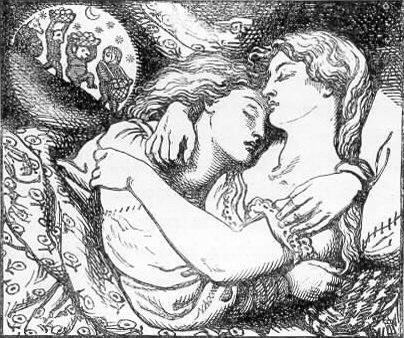
Lizzie and Laura, from a woodcut design
by Rossetti's brother.
   Binge and you will regret it.  Lizzie and Laura go to market, a 'Goblin Market' (Christina Rossetti - 1862).  Laura wants to eat the goblin's fruit but has no money, so they agree to accept some of her hair as payment, then she
[...] sucked their fruit globes fair or red:
Sweeter than honey from the rock.
Stronger than man-rejoicing wine,
Clearer than water flowed that juice;
She never tasted such before,
How should it cloy with length of use?
She sucked and sucked and sucked the more
Fruits which that unknown orchard bore;
She sucked until her lips were sore;
   As readers, we do not need cautiously  to invoke Freud to read this poem sexually.  No one could really face a charge of over-interpretation if they were to assert that there was a sexual element to Laura's feverish sucking on the goblin's fruit.  But if we sidestep (and it has to be quite a big step) a sexualised reading of the poem, it becomes a tale of suffering through excess.  Laura is made to suffer for her indulgence with the goblin men.  So many runners try and address either their desires or anxieties about fitness in one run.  It may not be a wise method for planning a week's running, or a month's for that matter.  Think what you might be able to do, then cut back on that because you are probably not experienced enough to plan your running, then pare it again just to make sure you don't suffer an early injury.  If the figure you're left with is a few hundred yards, well that sounds just about right to me.  Laura gobbled too much and it put her off for life.


3. Be kinder to yourself
The shudder in my son’s left hand
he cures with one touch from his right, 

two fingertips laid feather light 

to still his pen. He understands
   the whole man must be his own brother 
for no man is himself alone; 
though some of us have never known 
the one hand’s kindness to another.
   In Don Paterson's 'Correctives' the tender image of one hand laid upon another is a peculiar moment of transaction precisely because it asks is one, one, or is it two?  The son becomes the soothing parent to himself.  For all its lightness of touch, it is a potent metaphor, one that suggests a fundamental split in the self between the mind and the body.  Furthermore, the poem's real beauty lies in the simplicity of its solution.  The son's featherlight touch is one that demonstrates an act of caring that we are all capable of, but too often ignore.  Sometimes, we need as little as one hand's kindness to another to get us through.

Tuesday, 21 June 2011

"Mum?" a barely-toothed mouth asked, "What's that man running from?"


I had got lost on Peckham Rye; I was on a 7-miler.  7-milers are nice.  I can just about get away with not taking any water, and I do not have to worry too much about food, before, during, or after the run.  On this day, I had done one of the middle miles at racing pace.  I was done in.  I had slowed to about 9.30 but my heart rate just would not go back down to a workable rate.  My asthma was not good.  Some breed of tree was obviously in the throes of squirting its junk upon an unsuspecting London and my windpipes (and those of countless others, no doubt) were swelling up in response.  This was a hard run. 
I was in the final couple of miles of the run on one of the quiet side-streets off the park, where, approaching me was a young, pre-school, lad a few paces ahead of his mother.  He had the astonishingly good manners to move to the side to let me pass.  As I did, he squinted up at me, looking me in the eye, he called out with his economically-toothed mouth, "Mum?  What's that man running away from?"  Me and 'mum' both boomed with laughter as I struggled to think of pithy response.
Taken on one of those glorious runs on the South Downs
It was a good question.  People run away from things all the time.  In the summer of 2006 I was doing a fair bit of running, my mileage slowly climbing towards the kind of inevitable injuries that used to plague me.  It is too long ago to remember how much, or how often, but it was less than now, and more than any other time in my life.  After a few months of this, the weight began to fall off me.  I got quite tanned because I was always out running in the sunshine.  I lived at the northern end of Brighton on the south coast of England so could run only a mile and be on the South Downs.  Glorious sunsets were to be had most evenings.  There was also the silence, punctuated only by the occasional roar of a car and the chatter of birdsong.  Most importantly, there was solitariness.  I did not take my phone out with me.  I could be absolutely alone for however long the run took.  One weekend, at dinner with a couple we knew, the conversation turned to my running.  My friend's wife, always the one to say the least out of the four of us crashed through the conversation like a juggernaut when she meekly asked her husband in a stage whisper "But I don't understand, what's he running away from?"
Was this a joke?  I don't know, but I doubt it.  I did not take it seriously at the time, but a few weeks later I left a relationship that I had been in for nearly seventeen years.  Life found an answer to a question that I could not understand.  Since then I have seen the process happen to others, too.  They start to take more care of their appearance, spend a bit more on their haircut, lose a bit of the flab, get their teeth done, start exercising.  The process builds slowly, but they (or I) are being slowly drawn back, like an arrow in an archer's bow.  Finally, they reach the point when they are quivering, almost bursting, with tensile energy waiting to be released.  And they are gone.
So why do I run now?  What is the answer to the wee boy's question?  I do not run to assuage the kinds of anxiety that I was trying to make sense of in 2006, nothing like.  But I do still feel drawn to it.  It is a way of stamping out the difficulties of redrafting a book, thinking about how to tackle a tricky lecture, or wondering why an article’s argument does not quite make sense (the list goes on).  It is a way to be both profoundly alone and free. 
In one of his many notebooks, Leonardo Da Vinci wrote that freedom is 'the chiefest gift of Nature'.  Running certainly does give you a sense of freedom.  You own ('own' is the wrong word) a landscape in a way that is unique to running.  You are less governed by distance, route or venue than almost any sporting activity.  It is also a means of escape.  For me today, it is principally a means of escaping from the chair in my study without guilt.  When you are writing a book, article, PhD thesis, Masters dissertation, or a school essay, there is so much guilt; you could always be doing a little bit more than you are.  And Thomas Carlyle’s thesis on intellectual achievement is not much help: he believed that it was little more than ‘an infinite capacity for taking pains’.  But I never resent or feel guilty about the time I spend running.  Never.  I can go running for two hours, return, express mild surprise at the time passed and get back to work.  For a man of a certain age it is also, obviously, a way to escape the thing that I shouted in reply to the little boy's question.  “What is that man running away from?”  The best I could muster in response was: “old age.”  Only 'mum' laughed.
Edward Thomas
Walking was for the poet and philosopher of nature, Edward Thomas, also a means of escape from crippling depression.  It all-but ruined his relatively short life (born 1878, he enlisted in 1915, and was killed in action two years later at the Battle of Arras).  His widow, Helen Thomas, remarked that 'his greatest pleasure, and certainly his greatest need, was to walk and be alone.' (‘Oh, I like him’, I thought).  Those that suffer serial depression, even those that do not, gambol through various inoculations against the disappointments that modern life flings at them: drink, drugs, TV, porn, sugar, chips.  All of these, though, are about putting something else in, adding another ingredient to an already chaotic and confused chemical recipe.  For many, the answer is not to balance the equation.  Modern melancholia does not need a modern, deep-fried, or sweetened solution - it needs a very old one.  It needs other life.  As Marwood says in Bruce Robinson's Withnail & I, 'We are indeed drifting into the arena of the unwell, making an enemy of our own future.  What we need is harmony, fresh air, stuff like that.'  That is the pull of running.  To take 'time out of mind' (as Bob Dylan said) and immerse yourself in something that is in balance, that is part of a system that is billions of years older than you are, and to osmotically absorb some of it, at least for a time.  It is a way to experience a kind of freedom that we do not often get sight of in modern life.  But be warned, it is just as addictive as all of those 'bad' things.  Nowadays, even the sight of a landscape painting instils in me a deep desire to step into the frame, and beyond it.  To run toward the horizon, feeling the cool grass beneath my feet, and be gone.


Monday, 20 June 2011

Running for phenomenologists (no, really)

Merleau-Ponty (thinking, probably)
Maurice Merleau-Ponty the phenomenologist (now, come on, stay with me, it'll be OK) suggested that one of the major misunderstandings of modern philosophy was its interpretation of the body as a stable space from which to perceive the world.  The body is what belongs to us, everything else in the world is external to it.  If you hold up your hand in front of your face, it looks, feels, smells, different to every other hand in the world because you have a unique relationship with it.  Of course you do. It is different from any other hand in the history of all species quite simply because it is yours and no one else's.  And this is one of the mistakes that phenomenologists notice in our interpretation of the world.  Your body isn't just there, holding you upright so your eyes can see.  Your body isn't just something that passively experiences phenomena.  No, your body is what makes possible the experience of those phenomena.  ''Visible and mobile, my body is a thing among things; it is caught up in the fabric of the world and its cohesion is that of a thing. …the world is made of the same stuff as the body.' (Merleau-Ponty, 'The Primacy of Perception').  There is a sombre Hardy poem ('Proud Songsters') that expresses the same kinds of interconnectivity where the speaker of the poem fleetingly reflects on the web of the natural world.  The poet listens to birdsong, then he reflects

  • These are brand-new birds of twelve-months’ growing,
  • Which a year ago, or less than twain,
  • No finches were, nor nightingales,
  • Nor thrushes,
  • But only particles of grain,
  • And earth, and air, and rain.
Our experience of the outside world, of other bodies, of eating a bad meal, of seeing a beautiful landscape, these are all made possible, or altered, by the kinds of bodies that we have.  If everything's connected, everything's perspective.  So if you change your body, does that change the landscape?

When I started running properly again, a year or so ago, my legs and lungs were weak.  I was heavy.  I had started walking, but I was still quite a weight. You stick with it, and you find that after a few weeks you can run (I say run, I mean 'run') 3 miles.  It's a nice spot to get to because you are just starting to get your first whiffs of the runner's high.  You are beginning to see the point of it.  It is starting to feel like you are not a) wasting your time, and b) making a complete show of yourself.  You are burning a few of hundred calories a pop.  You might not be much thinner, but you will feel it.  At this point, I don't really feel that much has changed in your relationship with the world.  Reading this, now, try and think of something 3 miles away.  Now imagine covering that distance to get there.  It's not such a stretch is it?  If you had to walk 3 miles you could almost certainly both picture it and manage it.  As long as you don't wear those shoes that really pinch, or it's not raining, most people could happily manage this distance.


Downe House, Kent - as it was when someone drew it
Over the next few months, though, your body changes.  Not to look at.  You might be slightly trimmer round the midriff, but otherwise you look the same.  You are not the same, though.  You are much stronger.  The landscape that you can see and feel and sense is much, much larger, too.  Do the experiment again.  Think of something 11 miles away.  You probably can't, but if you can, try to imagine the route to get there on foot - the climbs and falls, the variety of camber, the changes of surface you'd need to cover.  Can you honestly do that?  I'm not bragging when I say that I can.  If you know any runners, they will tell you the same.  Without checking I can tell you that it is about 11 miles to Notting Hill from my house.  A quiet route through South London would get me there in about 2 hours.  I wouldn't need any special shoes (any of the ones I run in would be fine).  The weather wouldn't matter that much, either (I even ran in a blizzard on Blackheath last winter - somewhat predictably, it was lovely).  I'm pretty sure that if I headed in the opposite direction, 11 miles would take me to Darwin's house in Kent... (freaky, I've just checked on Google maps and, wait for it, 10.9 miles).  It's not just this spatial relationship that has changed.  I can't look at pictures of a landscape, of almost any kind, without thinking about running through them, over them, to the side of them, beyond them.  Rural, industrial, urban, desert; I always think about running on them (more on this later).


I was reading a collection of essays by John Gray, a searingly intelligent pop philosopher (he'd clock me one for that, but it is supposed to be a compliment) that was bought for me for my birthday (thanks Adam).  In it is a piece about when the trains failed in London a few years ago.  He writes from the perspective that although the power outage it was reported as an aberration, he sees it as a warning about the sustainability of the way we live in the West.  How stupid, he believes, that we think that our super-consumption of resources (of all kinds) is one that the rest of the world ought to aspire to.  He thinks, instead, that the lights will continue to go off.  This is only the beginning.  The trains will come to a stand still.  Chip-and-pin card readers will fail. Ocado deliveries won't show up. As E. M. Forster succintly put it in the title to one of his short stories, 'The Machine Stops'.


Last Christmas, the trains did stop because of 'snow' (or maybe it was a few breadcrumbs from the stationmaster's BLT). I was having a drink in town with a friend and we 'stupidly' stayed out till 7.30pm, by which time the stations had all closed.  People were losing their minds.  I shrugged, popped in my headphones, and spent the next few hours walking all the way home.  A few months before, my body would never have stood for that.