Friday, 26 April 2013

Hardy and the Birds


"What's on the wireless?" he said.
"About the birds," she said.  "It's not only here, it's everywhere. In London, all over the country. Something has happened to the birds." 
     When Daphne Du Maurier’s short story was first sent to her publisher to read, he told her it was ‘a masterpiece’ (Victor Gollancz was not often forthcoming with praise).  I am ashamed to say that I have not seen the Hitchcock film. The story is set in Cornwall, after the Second World War, a small family is trying to make its way working the land, and working for local landowners.  The tension in the story builds slowly from one that tells of freak encounters with nature to becoming one about the terrible dread of an all-out apocalypse. The birds – every one of them, gulls, wrens, sparrows, hawks – attack the countryside’s inhabitants.   Flailing arms, fires, shotguns and cars are useless against their sheer numbers.     Radio broadcasts from London cease.  Flocks bring down aeroplanes.  They smash through windows and kill householders.  Neighbours are found dead.  We never find out why.
     Their behaviour is inexplicable.
     They are birds.
     When I used to run along the seafront in Brighton there was a sight, familiar to us all no doubt, that I tried countless times to photograph but it was uncaptureable.  Waves of starlings would tidally swoop and swirl, sometimes for hours, around the bombed-out remains of the West Pier.
     You cannot grasp in a frame the soaring and stunning four-dimensionality of this dance of clouds. As Ruskin said of water, 'It is like trying to paint a soul'.  The sight is an overwhelming one: centrifugal spinning and turning like ink in water.  This movement cannot be reduced to the stiff and flattened dimensions of a photograph.
   We look up and witness that.  I wonder what they see when they look down at a crowded mass of 35,000 people in their two-dimensional world? Do they watch them shuffle through the funnel of the marathon startline like shapes on a piece of paper?  We share much experience with birds: we eat, we sing, we shit, we live, we die, but there is no language that can describe the wonderful fluidity of this sight. They are just so different from us.
      Taking 'time' out of the equation, we pretend that we live in three-dimensions, but we don’t – not really.  We do occupy the third dimension (of course we do), but we don’t regularly take advantage, or make much use, of it.   I was lucky enough to go to New York a few years ago, and there it struck me for the first time how very flat our lives can be.  Being shown to my hotel room I had to equalize in the lift, and then decompress on my flight back down to the lobby. Throughout the few days of the stay we were always moving across, along, high-up and all-the-way back.   It is the only place that I ever really noticed this; elsewhere we just seem to exploit two dimensions.  Edwin A. Abbott’s satirical Flatland of 1884 is a gem.  It is a post-Euclidian fantasy of inter-dimensional travel where beings (shapes) who live in the two dimensions of Flatland struggle to understand the possibility of a third.  The polygonal hero meets the Sphere who tries to explain the third dimension.  To do so, they travel to one-dimensional Lineland, and no-dimensional Pointland, where they appear as an idea in the head of its only inhabitant. It is like Plato’s Cave in The Republic where the ‘truth’ teller is ultimately punished for possessing dangerous and fantastical ideas.  But Flatland is also about our inability to see beyond the dimensions of our own comprehension.  The 2D and 3D dimensional-tourists do actually appear to the inhabitants of Lineland, for example, but only as one-dimensional lines (not the squares and spheres of their ‘real’ bodies).  Ultimately, the novel is a satire that exposes our inability to perceive that which we are not programmed to see.    Hardy also tries to make us aware of such perspectival partiality in The Mayor of Casterbridge in describing the eponymous city: ‘To birds of the more soaring kind Casterbridge must have appeared on this fine evening as a mosaic-work of subdued reds, browns, greys, and crystals, held together by a rectangular frame of deep green. To the level eye of humanity it stood as an indistinct mass behind a dense stockade of limes and chestnuts, set in the midst of miles of rotund down and concave field.’ Hardy does his best to subsume the mysteries of brickwork, roads, roof slates, and the windows of the townscape into a kind of avian cognitive representation. The brevity of the language may appear half-hearted but the simplicity and directness of it is its strength.  The bird’s eye description uses only visually-descriptive abstract nouns, for humanity the trees’ proper names are reinstated - correct taxonomy is a human endeavour, not a natural one.
     Much later, in his notes that would become the Philosophical Investigations, Ludwig Wittgenstein, always a savant philosopher riveted by the powers and peculiarities of language, wondered

25. It is sometimes said: animals do not talk because they lack the mental abilities. And this means: “They do not think, and that is why they do not talk.” But – they simply do not talk. Or better: they do not use language – if we disregard the most primitive forms of language. – Giving orders, asking questions, telling stories, having a chat, are as much a part of our natural history as walking, eating, drinking, playing.
                                                                              Wittgenstein – Philosophical Investigations

     They do not talk means only that they do not talk.  Did Wittgenstein really believe that they did not use language, that they did not communicate?  If like me you have run in a field of crows and met their stare – and I am sure you have – you could not even consider that they do not think.  The stare is not unidirectional, it is returned.  We may see ourselves in it, but there is something else there too.
     In 2008 an ongoing study was first reported that had been conducted at the Washington School of Forest Resources in which crows were trapped, banded and released by mask-wearing staff. They discovered two surprising things. First, that after five years and counting, banded crows still remembered the masks and would hound and dive at the staff. Second, that crows that were not involved in the experiment in any way also joined in the angry mob that jeered the mask-wearing staff over a mile away from the original incident.
     John Marzluff went so far as to assert that some of the crows were able to ‘make and use tools, forecast future events, understand what other animals know, and — in our [experiment] — learn from individual experience as well as by observing parents and peers’.   The birds were capable of ‘advanced cognitive tasks shown by only a few animals’.
     So they do not use ‘language’ professor Wittgenstein, really?
     Hardy again dramatizes the complexity of our anthro/avian relationship simply and effectively in the opening pages to Jude the Obscure.  The young Jude is employed by the farmer as a living scarecrow – they had gotten used to the static and silent kind.  The young Jude, though, empathizes with the birds
"Poor little dears!" said Jude, aloud. "You SHALL have some dinner - you shall. There is enough for us all. Farmer Troutham can afford to let you have some. Eat, then my dear little birdies, and make a good meal!"    They stayed and ate, inky spots on the nut-brown soil and Jude enjoyed their appetite. A magic thread of fellow-feeling united his own life with theirs. Puny and sorry as those lives were, they much resembled his own.
     No reader of Jude the Obscure forgets reading it.  The punishment meted out to Jude in the novel is so unrelenting that Claire Tomalin recently described the experience of reading it to being continually slapped in the face. In chapter two of the novel, Jude’s empathy with the birds reveals him as one not fit for the battle of modern life upon which he is about to engage. Civilization requires disconnection from nature, and this is Jude’s tragic flaw: he is of the earth, yet he seeks out the city and society of Christminster.  The city, just like Farmer Troutham, does not care for this ill-adapted and unfit specimen.
     When nature meets culture they do not speak in the same language.
     For me, one of the harder things about living in London is the litter. Litter is such a strange word. It sounds clean, like someone has crumpled up a blank piece of paper and tossed it aside to become a tumbleweed snowflake. When I say litter, I mean the mysterious and variegated palimpsest of stains that tattoo the pavement like some antique map, liquids that had flowed-across or impact-splattered onto the concrete; or Big Mac boxes and Red Bull cans, flattened and tyre-tracked; a laceless shoe; jewels of broken glass; a Capri-Sun sachet with a pink straw extruding from it; blackened chewing gum; broken elastic bands; mouldy trays of tomatoes; even a bed – it was a double.   All of these have featured in the ‘still life of modernity’ at the bottom of my road. The worst of these, though, is one of the most regular offenders: chicken bones.  Stepping on one is utterly gruesome. It was once a body, now here is a single piece of it. It has been held in someone's hand - traces of the grease are probably still on their fingers.   It has been in someone's mouth. And now it is tossed aside. Under your shoe, it crunches to the marrow in that flint-sharp way that only chicken does and you are now carrying a little piece of this confluence of biological history with you.  The interconnection is complex, intimate, somehow wrong.
     There is a convergence of chicken opportunities at the turn of our road.  There is a KFC (which as Jonathan Safran Foer has recently noted, now stands not for Kentucky Fried Chicken, but for nothing - it is just K.F.C.). There is also a Chicken ‘heaven’, ‘paradise’ or ‘cottage’ - I could check the name by walking a 100 yards down my street, then write pages on the trickeries and nuances of their shudderingly awful and misleading brand name and happy-chick logo, but they just don’t deserve the effort. In a moment of weakness – I think it might have been my birthday – I called in there for a veggie burger and chips.  It wasn’t very nice.  At 4am I was feverishly vomiting the lot back up.
     On another morning I woke up to find a rib on my balcony. I did not check but I don’t think it was a human rib.  It was cut cleanly and there was nothing on it.  A machine could not have removed the meat from this bone more efficiently.  I live several floors up so I don’t think a drunken (or sober) passer-by could have managed the throw.  It must have come from the sky.  But from where?  How far had it travelled?  Where was the rest of its body?  Dispersed throughout the take-aways of Europe?  In a freezer somewhere?  Buried and forgotten by some dog in a suburban garden?  Eaten?
        John Clare was fluent in the exploration and the sinewy complexities of our relationship with the natural world. This is from ‘The Badger’
The dogs are clapped and urged to join the fray'
The badger turns and drives them all away.
Though scarcely half as big, demure and small,
He fights with dogs for hours and beats them all.
[…]
He tries to reach the woods, and awkward race,
But sticks and cudgels quickly stop the chase.
He turns again and drives the noisy crowd
And beats the many dogs in noises loud.
He drives away and beats them every one,
And then they loose them all and set them on.
He falls as dead and kicked by boys and men,
Then starts and grins and drives the crowd again;
Till kicked and torn and beaten out he lies
And leaves his hold and crackles, groans, and dies.
     There are numerous ways that this poem may be read: as a metaphor for man’s troubled relationship with Christ, as metonym for Clare himself and his treatment by society or even in the lunatic asylum that he spent much of his later life, or is the badger a synecdoche for nature itself?  All of these readings are productive, but the final one is a brutally pessimistic vision of what happens when civilization and nature meet. In this reading the choice of the badger is an apt one because its suffering is of no use.  Foxes kill chickens.  Wolves kill sheep.  The powers of nature (dogs, sticks and foxes) are rallied against the badger but for no reason beyond that of the baiters’ savage fun.   The poem holds up a mirror to sanity and civilization and in any of the readings I have suggested, we are always the baiters.
     For John Berger, the companionship that we once had with animals is quickly being lost. Mechanization, profit, and interference in the food chain have all become a normal part of what we understand as industrialized animal agriculture. We pay for it with health scares and pandemics like BSE and H1N1, among others.   Each exposes the tenderness of what to me at least – and to many others I’m sure – is a clear dividing line of opposition. Nature surely should support civilization, not be plundered, consumed and destroyed by it.   If the foundations are destroyed what chance is there for the structures it supports?
     In History and Class Consciousness, Georg Lukacs suggested that nature ‘acknowledges the meaning of what has grown organically, […] in contrast to the artificial structures of human civilization.  At the same time, it can be understood as that aspect of human inwardness which has remained natural, or at least tends or longs to become natural once more.’  For Berger, here, ‘the life of a wild animal becomes an ideal, an ideal internalised as a feeling surrounding a repressed desire.’   But this desire does not need to be either repressed or a hopeless ideal.  In Berger’s terms it is unattainable, but there is more than the either/or option than he suggests.  The desire to return to nature is knowingly unattainable and fleeting, just as the blissful satisfaction of a drink of chilled water after a long run is also only a fleeting pleasure, but the pleasure brings with it real and necessary benefits to the body that have a far greater longevity than the few moments of satiation that they delivered.
   The desire to return to nature may be a hopeless ideal, but it is still one that we can turn to.
    For me, Du Maurier's birds are a fervid and omnipresent reminder of our uncanny relationship with modernity, we are not at home in its skin - we should be in ours.  They are a reminder too of our inability to leave behind the natural world, and perhaps the story is an exercise in our guilt at taking possession of it so fiercely.  These are after all, as Marzluff suspects, things able to ‘make and use tools', forecast the future, understand other animals and learn from them.  They are capable of ‘advanced cognitive tasks’.
      Today, slowing for the last hundred yards before home, I readied myself to negotiate whatever ‘litter’ might be waiting for me.   Turning the corner I saw two pigeons fight as they pecked and tossed a dirty, gnawed chicken bone.

Friday, 19 April 2013

Hardly Working - the idle runner


There are no sweeter ill-gotten gains than moments of stolen idleness.
But what is so wrong with doing nothing? Why is it so hard? Erich Fromm has argued that ‘there is no other period in history in which free men have given their energy so completely for the one purpose: work.’  Working hard is a boast. Working hard is good.  Working hard contributes to society. 
I’m an academic and as a species we share one thing in common.  If you speak to an academic, they are likely within the first sixty seconds to tell you about their workload. Like everyone, we work hard.  We forget the work-life balance.  We don’t take anywhere near the holidays that we are entitled to. We find it impossible not to check emails. (My colleague currently has over 1000 ‘saved for reply’ ). I usually check them every few hours. If I don’t, I spend the equivalent time imagining them piling high while I’ve got my back turned.  It is like playing Grandmother’s Footsteps, and the loser of the game gets to respond to hoards of unnecessary queries (‘Dear Vybarr, Your essay question says “strictly no more than 3000 words”, so is 3600 OK?’).  I love running because it is a fine way of doing nothing, of lazing in an unproductive co-operation with the world.
      As Fromm explained, the Christian work ethic now dominates in our culture - but where does it come from?  Not from Christ certainly, whose Sermon on the Mount explains  “Consider the lilies of the field, how they grow; they toil not”. Idleness is attacked from so many directions in our culture and I think, like many, I have internalised this.  It is like a concrete wall of double-think that I always have to push against. The only way I can combat it effectively is to run away.  I leave my phone, I leave my emails, whatever crisis is brewing has to wait. And when I run, I don’t waste a moment wondering what is happening elsewhere because the immediacy of the now takes over in a way that it cannot elsewhere. Everything has to wait. But what is so wrong with doing nothing, for a bit?
In a brilliant essay from 1932, philosopher Bertrand Russell spins a tale:

“Everyone knows the story of the traveler in Naples who saw twelve beggars lying in the sun (it was before the days of Mussolini), and offered a lira to the laziest of them. Eleven of them jumped up to claim it, so he gave it to the twelfth. This traveler was on the right lines.” 

Russell’s essay - one of the least crackpot of his oeuvre - continues along the lines that so little work is necessary, we should consider reducing our hours of work to about four per day. This should be sufficient to “entitle a man to the necessities and elementary comforts of life, and that the rest of his time should be his to use as he might see fit.”  He suggests that it is is “a condemnation of our civilization” that we find the notion of so much leisure time unthinkable.  His belief is that leisure produced Ruskin, it produced Darwin, it produced Carlyle, Freud, Marx, Newton, Curie.  In such a world ”every person possessed of scientific curiosity will be able to indulge it, and every painter will be able to paint without starving”.  Russell also would have found the queen of crime on his side - Agatha Christie said that “necessity was not the mother of invention, but idleness.”  
Insight rarely comes when it is searched for.  It is always at 4 am, or in the shower, that solutions to problems suddenly click into place.  When I’m running, I don’t hear the ‘click’, but the problem sort of falls away, out of sight, and by the time it comes back into focus, I find it rearranged and suddenly more straightforward than when I last lay eyes on it.  It is IN these moments of idleness, of separateness, in our daydreams, in our absence, that the truth so easily hidden in the camouflage of the everyday, silently floats to the surface, glyptic and clear.


Tuesday, 16 April 2013

Discovering Gilgamesh

Vybarr Cregan-Reid - Discovering Gilgamesh - due out August 2013

Wednesday, 10 April 2013

Spring is sprung (noisy runners)


I went for my first barefoot run of the year, today.  Spring is sprung.

Why the first? If the ground is too cold, your feet go numb and all of the essential cutaneous feedback that is so desperately needed for barefoot running is lost in the numb of the cold.  One of the things that automatically happen, at least to me, is that as soon as my shoes come off, I immediately start scanning the ground about ten feet in front of me.  Every little piece of grit, gravel or crack in the stone has to be computed and avoided.  This might sound tricky, but it is achieved with remarkably little effort, and certainly no practice.  But something miraculous happens when you make an error, and it is why you need to be able to feel what's beneath your feet.  So you lose concentration, easily done, and you step on a medium sized pebble.  Before you can 'think' a response to your error; before you can tense up to brace yourself against more pain; your body has already responded and dealt with the stone.  If the muscles in your foot were to tense up, they become more likely to tear.  So, just like when you catch something in midair before you consciously know that you have dropped it, the muscles in your feet at the precise point of impact, go soft.  Your weight shifts around the pebble, but not onto it.  By the time your brain has realised what it has done, the problem is already addressed and dealt with by the foot and you are moving on to the next stride. It is a miraculous experience. Our bodies know more about the world than we do.

The second thing that I re-realised about barefooting today was the silence.  Even in the most minimalist of minimalist shoes (Vivobarefoots, Vibrams, or the ultra-whisperers - Nike 3.0 v2s), there is always the click of the sole onto concrete.  But, there is no mistaking the tender quiet of skin.  You move with such mineral stealth that you can barely hear your own feet.  It's is not so straightforward as this, but I can't help but believe that the reason so many people find that skinning is the mysterious cure for their injuries is that their running technique is immeasurably improved without protection.  Imagine how carefully you might drive if, instead of an airbag, there was a spike waiting to impale you at your first careless error. Skinning is treading softly, more softly than you would believe. It is the finest of all running experiences for me.

To give you some idea of the difference, here are two files.  One is a recording I made of someone on a treadmill at the local gym. The only other one I have is from the Venice Lido (my apologies - I never meant this for public consumption.  It is the sound that matters) - compare for yourself the different noise levels and consequent impact gradient of these two runners - then decide which you'd rather do.


The recordings were made with the same phone, without any sound adjustment. The barefoot one was not made for public consumption - just several miles into a run in Venice and it seemed like a good idea at the time.

Thursday, 4 April 2013

Impressionist running


Coleridge once wrote in a letter to his friend, Thomas Poole, 'Those who have been led to the same truths step by step thro' the constant testimony of their senses, seem to me to want a sense which I possess - They contemplate nothing but parts - and all parts are necessarily little - and the Universe to them is but a mass of little things.'
Connection.  It’s what it’s all about. It’s why I run.
I was running in Devon last year when something struck me.  It had been raining for a solid fortnight and I had hardly run.  I was still a little tired from the marathon so the break was a welcome one.
A Devon field, so warm it felt like it was breathing.

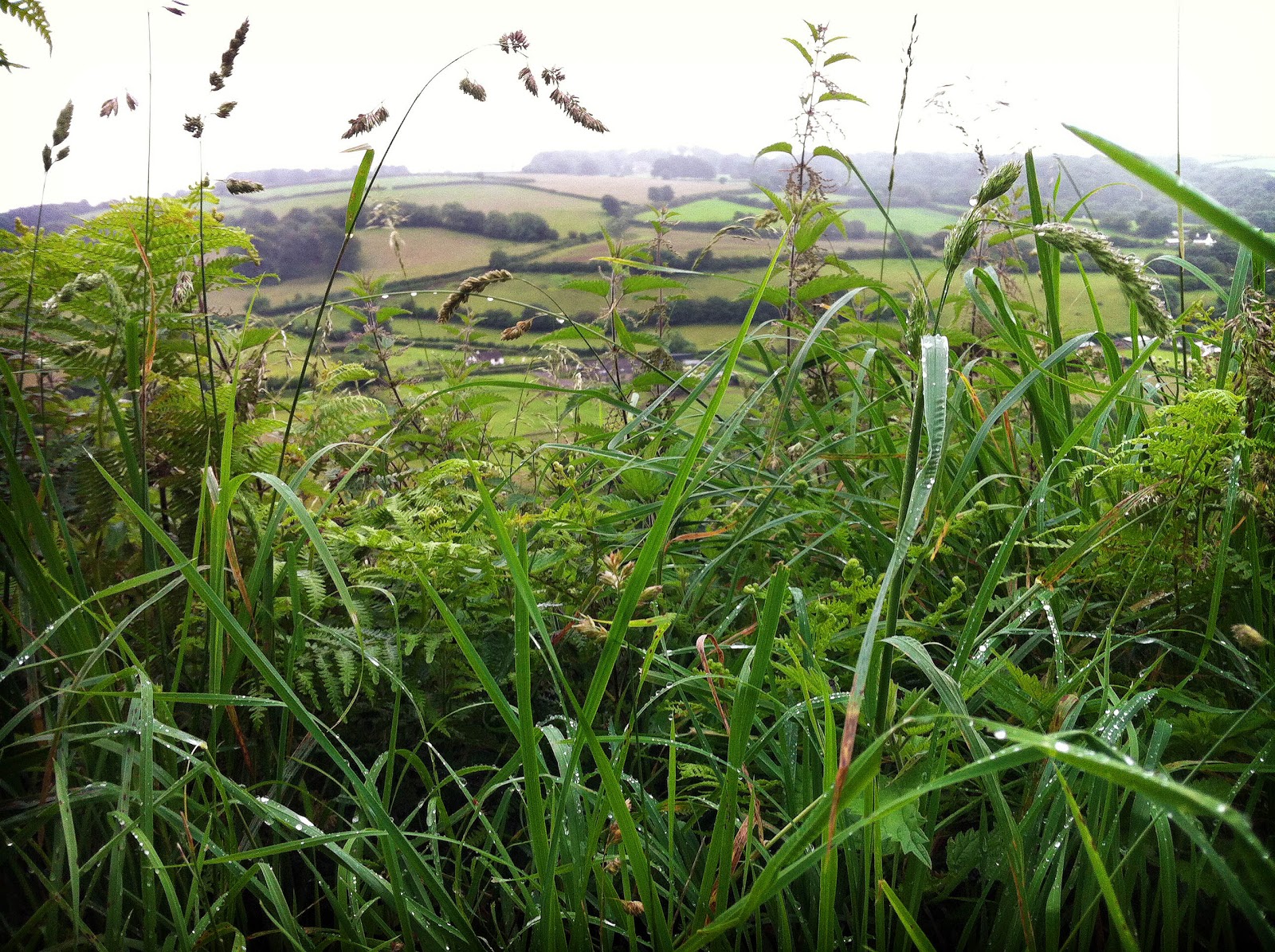
I was in Great Torrington, an old Cavalier town.  The pavements were glassy with rain and then the sun came out, and so did I.  As an old fortress town, Great Torrington is high up on a hill, so the beginning of any run is easy, quick and light (although I am fully aware of what will happen when my circle is complete and I will have to clamber back up the ramparts).  Nearby, there is a disused railway - one of the many casualties of the demon Dr Beeching’s cuts in the 60s. Now, the area is overgrown.  There is a narrow concrete path, but it is being besieged by the life of the embankments on both sides.  The maze of green is made of wild clematis, euphorbia, and hundreds of different grasses of such varied air.  Ferns, swaying elder, wild strawberries, clambering roses, and fingers of pollarded hazels all roll back to disappear into the darkness of a forest. The ground cover and the spears of grass pointing skyward look crosshatched. The River Torridge is in torrent from all the rain, making thick silken curls of muddy caramel by its banks. Darting goldfinches and copper-blue dragonflies zip to and from my vision.  I keep my shoes on because it is impossible to see what lies beneath the surface of the squelching earth.  And there is something very strange about the heat.  As I run past one of the low-lying fields it pulsates warmth.  Like it is exhaling  a long hot breath in the sunshine, the heat comes and it goes.  After the rains, the land is alive, the lilac bells of foxglove grow like hooks out of the hillside to catch the sunshine that they’ve not seen for weeks. And the thought hits me: it is not profound.  This is why I love late Monet.  He does this. He ‘gets’ this. 
John Fowles, in his wonderful paean to The Tree, explained why he so despised Linnaeus. He thought that the system of classification took a chisel to the world and divided it (there is a wonderful Borges skit about taxonomy, too).  He thought that damage was done to nature in the act of naming, of separating things from one another, and failing to see the tender skeins of connection that lie between.
Hardy explains in The Woodlanders “In her present beholder's mind the scene formed by the girlish spar-maker composed itself into a post-Raffaelite picture of extremest quality, wherein the girl's hair alone, as the focus of observation, was depicted with intensity and distinctness, and her face, shoulders, hands, and figure in general, being a blurred mass of unimportant detail lost in haze and obscurity.” Hardy here is trying to achieve the same effect: one of impressionism.  Unlike John Everett Millais’ Ophelia where every blade of grass is lovingly recorded, Monet and Hardy are interested in the links between the things.  Look again at the Millais painting and you will see that although Ophelia first appears to be in nature, not a single leaf of grass or flower is touching her - she is quite separate from her surroundings. Monet’s late work was a response to this form of representation - unlike Canaletto who wished to the world atomistically, Monet bounds headlong at the canvas to record its connections because nature itself is sublime, and unrecordable.  In a diary entry Hardy recorded this: 'Nature', he wrote in December 1885, 'is an arch-dissembler... nothing is as it appears.' 
How can it be? There is only ever impression and connection. It’s why I run.


Great Torrington - overlooking the Torridge vale

Monday, 24 December 2012

A Runner's Work


A Runner's Work.

It's Christmas Eve.  The sun is going down.  I haven't run for nearly two months.  I have felt elementally tired, missing out on gifts of runs on St Andrews beach and elsewhere.  I have hated not running, but not enough to start again.
I have been here before.  I get tired of running. I stop. I get tired of stopping, so I run.  But this time it felt different.  I haven't stopped for so long before.
I'm packing to go away for Christmas.  As I descend through the drawers, I get to the 'running' one.  I fingertip the handle and move on to the next.  With electrical reflex speed I think without thinking that I won't need any of my running things. I'm not running for the rest of the year.  Something happens, though, when I go to pack my shoes.  I'm listening to the radio and before I realise what I'm doing I find myself removing a broken pair of laces on my favourite running shoes.  And, like I'm working hard with a coarse tapestry I am forcing the bright new laces through the eyelets and relacing them.  
What the hell!
Blackheath, at sunset.

In minutes I am out on the road.  I am imagining that this is going to hurt.  I am so out of practice I don't expect to go further than a mile without stopping.  
It is a lovely time of day to be running.  The air is unseasonably warm for Christmas Eve.  Everyone is busy in their front rooms.  Everyone seems to have their Christmas lights on.  Christmas is happening for everyone, so what the fuck am I doing?  Parents and children walk hand in hand in the street, coming or going.  And within a few minutes, the presentness of running reminds me of its essence and I realise, it is an experience and not a memory.  It is a mental state that can only happen and not be recalled with any reliability.  Then it strikes me…
Running is an aesthetic experience.  
No really.  I know this sounds like over-dignifying nonsense.  But it is the only way in which I can think that a runner's mental state can make sense to the non-running.  I always misremember great art.  It seems to have a space into which I move and do the aesthetic work 'with' it.  I have a much more reliable memory for art that doesn't interest me.  
Running, like art, is long.  It doesn't happen on any particular run, it's made up of multiple chapters.  When I was out on the road, I remembered a lovely bit from one of Van Gogh's letters "I must continue to follow the path I take now. If I do nothing, if I study nothing, if I cease searching, then, woe is me, I am lost. That is how I look at it — keep going, keep going come what may.  But what is your final goal, you may ask. That goal will become clearer, will emerge slowly but surely, much as the rough draught turns into a sketch, and the sketch into a painting through the serious work done on it, through the elaboration of the original vague idea and through the consolidation of the first fleeting and passing thought. (Van Gogh to Theo - July 1880).
Shit!  It's 5.30 on Christmas Eve, and like everyone else, I'm supposed to be somewhere else, but am thrilled that once again I want to keep going; keep going come what may.

Saturday, 29 September 2012

"I dance on this embodied earth" (2006)


Devil's Dyke, with the last of some low-lying cloud

    
      In 2006, the summer continues. The air is warm without the thunderous punctuation of rainstorms that we’ve had in more recent years. As the days, and eventually, the weeks go by a sky that had felt like lead, was beginning to feel something like air. Nothing was fixed or settled. I had no plans. I didn’t know what I was doing, or indeed what I was going to do. I had jumped over the side of the boat because the water looked inviting, but I had no idea of its depth or what lay beneath its glimmering surface. For now, the water was warm and I could swim. Almost everyday I would head out running, return, grab the dogs and take them out walking. This would earth the static that could build up over a matter of hours. On every run, my sillage was pollinated with these electrically charged particles that only a run could shake off.
     It is a couple of weeks later and I am becoming increasingly anxious about my new job due to begin in a few days. I have new courses to write, with new lectures, new students, new friends to make, and I couldn’t feel less ready than I do today.
     The air has turned. There are one or two bronze leaves in the street when I step out the door, but I don’t start running. I am going to drive up to the Downs. I want to do eight miles along the peaks into West Sussex.
    I am running something like twenty miles a week. This is the base from which I can start to think about marathon training. I could hold at this mileage for the next few months, up my training in January and do a marathon in the spring. What for, I don’t know - I just want to. It is five years since I have dared to think this. Practically the moment I applied in 2001 I was taken down by illiotibial band syndrome, more commonly known as runner's knee.
    On the drive, I worry if I have underdressed for the run; the air is always cooler on the peaks.
    The car wheels scrape at the chalk and flint of the car park as it skids to a halt. I don't have to park tidily, it feels like the world is locked in offices and classrooms. I wonder at how the earth can be so obtrusive in its presence, yet so few seemed to want to notice it. But then, neither am I sure that I am noticing much, so consumed am I by my internal ecology.

A knot of wild clematis stems.

   The colours in the trees seem a shade darker than a week ago. The leaves are showing the first signs of rust. The view, a little greyer. Summer, it seems, has departed for another continent, one ready, no doubt, to welcome it.
     The seasons trouble our idea of time's linearity. We take sharpened chisels to time: we chop and chip it for our own convenience. We find in it, days, months, weeks, years, all neatly manageable.
      At the beginning of the twentieth century, the geologist Eduard Suess was struggling to make sense of the model of deep-time that had emerged around the Victorian period. In a massive four-volume study The Face of the Earth, he argued that our problem in trying to understand the earth’s past was that we tried to conceive of it in human terms. It is a beautiful notion.

"The year is a measure of time furnished by the planetary system; but when we speak of a thousand years, we introduce the decimal system, and this is based on the structure of our extremities. We often measure mountains in feet, and we distinguish long and short periods of time according to the average length of human life, that is, according to the frailty of our bodies; [… W]e are prone to forget that the planet may be measured by man, but not according to man."

      Our inability to conceptualize what we currently think to be about 4.6 billion years derives from our frailly-human temporal and spatial perspective. The poets of the nineteenth century, though, had already got there. Though published later, Hardy's 'Proud Songsters' is a poignant reminder of the substance of life, of living being a temporary loan of fluid- and borrowed-matter, always in motion, stopping here before moving on to there. Always exercising itself between the senses.
      The poem expresses the same kinds of super-interconnectivity where the speaker of the poem fleetingly reflects on the web of the natural world. One April dusk, the poet listens to a round of birdsong and reflects on the workings of the world and of time,

"These are brand-new birds of twelve-months’ growing,
       Which a year ago, or less than twain,
       No finches were, nor nightingales,
   Nor thrushes,
But only particles of grain,
   And earth, and air, and rain."


The South Downs, looking north west.
   The earth, air, grain and rain in only a year or two becomes the 'proud' birdsong. Nothing conveys ephemerality for Hardy quite like birdsong (it was an image that he repeatedly returned to in his poems on time). For Hardy it is matter that is constant, not God, and certainly not us. But the wonder of life for Hardy is its uncanny ability to turn matter to energy, what was once soil and earth is now a fleeting song. Like the nightingale, the poet departs, leaving us on a floating moment: that what was finch, nightingale and thrush will in 'twelve months' be 'particles of grain, and earth, and air, and rain.' All is separate, but connected; different, but the same. Life is not finely individuated into species, plants, minerals, and elements, but all is part of a larger and contiguous structure. And, like Matthew Arnold’s waves that make the ‘grating roar / Of pebbles which the waves draw back, and fling, / At their return, […] Begin, and cease, and then again begin’ for ever more, in ‘Dover Beach’, the cyclical process in Hardy’s poem continues far beyond the boundaries of our anthropocentric imagination.
     The flight of time's arrow is unthinkably long. And there is no archer's bow, nor a target on which for it land. Neither it seems does it travel at an uninterrupted speed.
      The seasons introduce to us a kind of punctuated equilibrium. They remind us that time travels in phases, for months it is summer and then, overnight, autumn begins apace. I feel like I have had my summer of equilibrium, and this is its punctuation. Leaves must die and fall from the tree. There will be winter. Then the hope of new growth will begin.
       In the distance, to the west, is a thicket of telephone and TV masts that I am going to negotiate my way to, up, down, and along the winding chalk paths that look like exposed bone.
      A troubled knat, for miles I dance on the skin of this embodied earth. I would get down onto my knees and suck on its lifeblood if I knew how to break my way through its leathery skin.
       I can see for hundreds of square miles around. How can so much of this world be present, here, and yet it is so quiet? But there are depths of incompleteness to this withering silence.
      I can hear the wind whispering by my ears. A little more brittle, the leaves rustle with a drier sibilant edge they lacked only a few days ago. The air is part of a landscape in ways that we cannot always see, but it strums upon our perceptions of what is around us, thrumming chords that chime across our senses, deep into our hearts and memories.
      I can hear, too, the patter of the rabbits as they dart to their burrows. I always used to think they ran from my dog, Ben. He is always present up here. With the chill in the air I am reminded, too, of the misty December morning a couple of years ago when we sat down, here, the two of us in the long moist grass. Pulling gently at his ears, stroking him across an eye, scratching his ruff as we looked at the view together for one last time. Only five years old, I drove him from here to the vet who discovered, as suspected, many of his organs fused together by a massive lymphoma.
      A run seems to draw these memories up, but it also gives them air so that they can return once again to the deep waters.

The South Downs, facing north east.
    I pass the communication masts and the huts that I have never discovered the function of. I start my journey back to the dyke, wading through all of the past and the present with not a thought for the future. As I curl and climb the chalk path, the hills' sheep stare at this intruder like they cannot decide if I am predator or idiot - I cannot give them an answer.
      Climb. Fall. Climb. Fall.
      Then a long slow climb back to the peak.
       I begin to feel a stiffness across my knee. Wearily, I recognise it; but perhaps I'm mistaken and it is just tiredness. But it is on the lateral side of my left knee - the slightly longer leg that bows as my heel slams into the ground. I slow. I alter my gait to give my body a rest, but the stiffness increases. If I can make it to the top of the... but the stiffness closes around my joint like the handle is spinning on a vice, restricting its movement so much that I am practically limping to keep running. I stop and walk for a few steps; relief. Again, I make for the brow of the hill but the handle has spun to a stop; the vice has closed. The knee will not move anymore.
Every stage of this process I know well. I have been here before, maybe ten or fifteen times. This is the end. I cannot run for weeks. My fear and fury will keep me from it for months. The knowledge that this is how it always ends may keep me from it for years.
       All this time, it is like I have been trying to outrun a tidal swell, but the wave breaks, engulfing me, and my body says, 'No, that is enough. No more.'


Devil's Dyke at sunset 


Friday, 7 September 2012

Sillages - (a podograph from 2006)

Sillage - noun (from the French)  (a) A surge raised in the sea or other piece of water by the passage of a vessel. (b) The air current caused by the passage of an aircraft. (c) The sound of the surge of water. (d) in perfumery - a veil of scent that a person leaves behind when walking.


No traveller has rest more blest
Than this moment brief between
Two lives, when the Night's first lights
And shades hide what has never been,
Things goodlier, lovelier, dearer, than will be or have been.
(Edward Thomas - The Bridge)


THE DOOR SLAMS behind me with the tremulous percussive accompaniment of letterbox flaps, door knockers and dogs' paws.  The ‘naughty girls’ (my friend’s dogs) are furious that for the first time in months I am leaving the house without them.  The seagulls caw in complaint because I have disrupted their street party.  They have been jabbing and tearing at the bin bags that were left out overnight.
I kid myself that there is something coercive in the air today, something drawing me out of my temporary home.  There isn't.  I am running away from last night, from the phone calls, the shouts, from the indecision.  Running, too, from a Rilke sonnet that I read the day that I left and came to stay, here, in my friend’s house - to walk her dogs while she lies comatose from chemotherapy.


[…] Otherwise this stone would seem defaced
beneath the translucent cascade of the shoulders
and would not glisten like a wild beast’s fur:
would not, from all the borders of itself,
burst like a star: for there’s no part of it
that does not see you. You must change your life.

(Rilke - ‘Archaic Torso of Apollo’)


Since I read that poem there has been nothing but chaos, anger and mess.  The spewing rubbish bags with their stinking bones and carcasses and yoghurt cups mask the stench of today's sillage, the pollinated, charged, and multicoloured emotional scent trail that every runner leaves in their wake. To say it, is like a kiss.  You pronounce it 'see-arge', but not with the hard English 'g' like in 'large' or 'age', but with a slow French 'g', like the soft 's' in the middle of 'pleasure'.  
All runners have sillages, complex trails of emotional scent that are shaken off and left behind on their runs, and everyone’s is unique. But they are not like fingerprints.  While every runners' sillage may be different, unlike the microscopic curls, peaks and valleys on their fingertips, their sillages do change.  Slightly from day to day, but over decades they change their identity altogether.  Just as everything changes: what we are running away from, or what we are trying to leave behind, like a dog as it violently swirls and curls the water from its waxen fur.

The Downs aren't really accessible from here, not on foot, so I am heading for wide open parkland, and it's miles away.  Miles of ugly miles away.  The road is straight and very long.  For half an hour I have to crawl by four lanes of growling traffic.  This is life in greyscale.  The buildings all look like they have been drawn in pencil and sap the colour from the few trees that surround them. The cars are all gunmetal, lead, or dried blood.  My back arches as I run like I am flinching under the weight of all this.  The noise forces into retreat anything that may want to float up to the surface to be let go of and released into the air.
I reach the beginning of the park and can turn off from the pulmonary rush of the main road.  
If Brighton had a Royal Park this would be it.  There is a tiny village at the other end of it called Stanmer.  It has an old manor house and a church, bits of which date back to the fourteenth century.  The park is the last remaining soft green cushion between Brighton’s borders on one side and the ever-growing universities on the other, one of which is just over the brow of the hill.  Humphry Repton scalped and shaped this land in the early nineteenth century, succouring the Romantic sensibilities of the Earl of Chichester and his friends.  Now, the long and deep vale filters out the noise and architecture of other centuries and presents only itself to the visitor.
Why do I come here?  Why do I want this?  It’s like a kitsch version of the past; one fabricated and artificially protected by laws and fences.  A theme park done with dignity.  Welcome to Freedom Incarcerated.
Leonardo Da Vinci had a deeply engrained fear of imprisonment.  Some of his earlier designed machines from the 1480s were for ripping bars from windows, another could effect escape from within a cell. But in one of his notebooks he suggests a guiding desire behind such designs: freedom, he wrote, is 'the chiefest gift of Nature'; not beauty, a landscape, nor the scent of a rose, but 'freedom'.  From what?  
I would guess feeling enclosed, trapped, ‘time-torn’ (as Hardy put it in one of his poems), demanded of, desired and desiring.
The exercising of different kinds of freedom has been its own reward for many.
Walking was for the poet and philosopher of nature, Edward Thomas, a means of escape from crippling depression.  It all-but ruined his relatively short life (born 1878, he enlisted in 1915, and was killed in action two years later at the Battle of Arras).  He had a terrible temper and his illness did not hide itself from those around him.  His widow, Helen Thomas, remarked that ‘his greatest pleasure, and certainly his greatest need, was to walk and be alone.’ 
Modern life is like a centrifuge that spins us away from the earth.  Time passes, it gathers momentum, and we are left to struggle ever harder against a force that we cannot see.  
This kitschy place, with its perimeter fences that keep out the modern world is the promise and the reminder that things might be different.  It may be cordoned off from the world, but life bursts into the frame from every angle.  Ancient oak trees reach to the skies, there are orchids, fungi, grasses, cows and sheep, foxes, cabbage whites, adders, kestrels, badgers, deer, ducks, red admirals, wild clematis, bees, robins, wrens, sparrows, and bright red poppies like the landscape is wearing a clown suit. Life goes on, today, tomorrow and the next. 
The inorganic is not at home here; cars look strange and out of place, but we don’t. I don’t.  I share more in common with this wildworld and wildlife than I do with my overdraft or my Facebook status. 
When I run in it, I don’t feel that I am taking possession of this landscape, but I do become a part of it in ways that I can’t yet work out.
I am half way through the run; my diaphragm has loosened so much that it feels like my lungs fill all the way down to my hips.  My breathing is tantricly slow.  I feel like I could do this for the rest of the day - like I could stay out here until sunset, and may never have to go home.  I turn towards the hill and the tall meadow whose flowing waves, winnowing in the breeze, look like the sea.
Slowly, I climb towards the brow.  I flatten my hands to caress the tips of the long indigo grass as I glide by.  Between my fingers, the fronds are neatly combed, collected, and are gone.  Gently, like I am feeling the pelt of some sleeping animal that I fear to wake. Like someone has billowed a sheet of silk, the grasses shiver.  It seems to come from beneath the surface.


Saturday, 26 May 2012

The Smell of Rain (Petrichor and a Runner's Memory)


Rain seeps down into the concrete to release its complex scent.

  The air's heavy with a glitter of damp scents. Petrichor: the smell of rain rises from the ground. The concrete seems impermeable.  The tarmac, the grey and pink flagstones, the pebbles, even, have all been brought to life by something in the air.  Their smell is swirling and diving, like the sun-bright scent of flowers competing for the attention of bees.  But this is wrong.  Rain doesn't smell; it's something else.  Petra: of stone; Ichor, the golden fluid that runs in the veins of the gods and immortals. Is it the blood of stones that we can smell? Life is to be found in the strangest of places. 
   Certain runs are imbued with melancholy.  For twenty years I have walked, run, and cycled this track of seafront between western Hove and Brighton. The place bursts with innumerable memories of football, skateboarding, sex, sun, high-winds and storms.  This stretch would be so quiet some mornings, years ago, that I would sit up on my bike to catch as much of the chasing wind as I could.  I would take my rucksack from my back, still pedalling hard, rummage inside it and take out that morning's post, open and read it as I cycled none-handed.  But it's years since I've been here. And like I was on those hundreds of trips in and out of town, I am here again, alone. This time I'm folding a quick run into a crease of time between seeing two friends.  I have got no shoes with me, but it doesn't matter, I can go barefoot. The sky is grey, the sun on the horizon is the memory of a gold coin, a grubby smudge of yellow light dipping into the sea.  And the overwhelmingly dominant memory is of being happy while I lived here, before it all went wrong. A run through this landscape is like running on pebbles. Tender layers of memory give way beneath the weight of each footstep.
   Years ago, twenty maybe, as an eager young reader I came across Waugh's Brideshead Revisited.  It was about 1992 and I hated my dismal job so much that even if I was going to be 10 minutes early for work, I would pull into a lay-by and read a bit more Brideshead. I was glad of the experience at the time.  Pleased that I had got it under my belt, (where it joined the five other books I had read in my life) but the effect was oddly disengaging.  I assumed I had missed something in it.  And now I know what it was.   
   Take for example this scene.  It is the one where Charles is finally ejected from Brideshead by Lady Marchmain, so disgusted is she that Charles has helped her alcoholic son find some drink, she asks him to leave this besmirched Garden of Eden. At the time, he is unaware that he is doing so for the last time. He remarks,

MY theme is memory, that winged host that soared about me one grey morning of war-time. These memories, which are my life - for we possess nothing certainly except the past - were always with me. Like the pigeons of St Mark’s, they were everywhere, under my feet, singly, in pairs, in little honey-voiced congregations, nodding, strutting, winking, rolling the tender feathers of their necks, perching sometimes, if I stood still, on my shoulder; until, suddenly, the noon gun boomed and in a moment, with a flutter and sweep of wings, the pavement was bare and the whole sky above dark with a tumult of fowl. Thus it was that morning of war-time.
For nearly ten dead years after that evening [...] I was borne along a road outwardly full of change and incident, but never during that time [...] did I come alive as I had been during the time of my friendship with Sebastian. I took it to be youth, not life, that I was losing. [...] I had come to the surface, into the light of common day and the fresh sea-air, after long captivity in  the sunless coral palaces and waving forests of the ocean bed.'

   I was too young to make sense of this, the palimpsest of my memory was not a darkened one. This is how De Quincey saw it in his brilliant essay.  Memory is a palimpsest, a text scrubbed or scraped from the leathery surface but never absolutely removed. 

A palimpsest
Yes, reader, countless are the mysterious hand-writings of grief or joy which have inscribed themselves successively upon the palimpsest of your brain; and, like the annual leaves of aboriginal forests, or the undissolving snows on the Himalaya, or light falling upon light, the endless strata have covered up each other in forgetfulness.

   It was a rich metaphor. One of the handful of texts around this period that began to formulate the idea of the unconscious (before Freud went on to name a century later).  The palimpsest model of memory suggests that the mind is a stranger to itself, and also that nothing is ever really forgotten.  (The idea of one's life flashing before one's eyes at the moment of death is also introduced here).  But it works as a metaphor for other things, too.  De Quincey's own writings weave together reportage, biography, autobiography, essay, philosophy, journalism, memoir, (he was even an aficionado of murder) all thick with classical allusion and contemporary literary reference. The palimpsest is what his writing is. It's a metaphor for literature, too. Think of T.S. Eliot's 1919 essay, 'Tradition and the Individual Talent', it is De Quincey's idea from a century before given an Eliotesque twist.  The poet must combine their unique creative talent with the literary tradition that came before it in order to achieve greatness.  'The Wasteland' is a polyphonic palimpsest in which the tradition can neither be fully erased, nor ignored on the page.  It is resolutely 'there', speaking in tongues.  The past never really goes away.  

   Flying at the circumference of my vision are plumes of sun-blackened seaweed.  High in the air, it is the most ragged and 'blast-beruffled' crow I have ever seen.  It tries to climb, but the wind is too strong and it gives up. I never successfully 'see' it.  Its feathers too dark; its movement too chaotic in the high wind.  I'm reminded of a bit of Daniel C. Dennett that I also read (at the same time as Brideshead) many years ago.  Its the only bit of the book that I persistently remember, 'If the resolution of our vision were as poor as the resolution of our olfaction, when a bird flew overhead the sky would go all birdish for us for a while.' (Consciousness Explained). In memory, just like olfaction, the sky 'goes all birdish for us for a while' and we thirst for particular sense impressions to jog our memory into being.  Perhaps this is why olfaction is so kinaesthetically linked with memory.  Our sense of smell is undeniably poor, especially directional acuity, but particularity reaches fingerprint levels of specificity.  We can recognise with tremendous accuracy.  Think of what we can achieve by combining the twenty-six letters of the alphabet in variable combinations. Smell works a little like this.  Odour molecules, as they are bound, combine to create a sense impression, and we have about 350 active olfactory receptor genes. Each of these genes produces a receptor protein that binds odour molecules. That's an olfactory alphabet of 350 letters, and the words can be anything between 1 to 350 letters long.  The combinational possibilities are in the billions.  So Dennett is right, the sky does 'go all birdish' when we use our sense of smell, but we would be able to tell exactly what bird it is, and easily distinguish from another of the same species and genus.  We would know it's there, but we would not be able to point to it.


 Built for purpose, a soaring herring gull sits comfortably on the breeze like it has been pinned in place.  In the distance, I can see the tiniest cloud of starlings cloud-dancing around the charred remains of the West Pier.  The ground is wet and cold beneath my feet.  In twenty minutes, they may go numb.  Everything I see is so distinctly Brighton in a way that only someone that does not live there can notice.  There is a woman with tangerine hair.  But not the kind that you'd put in the fruit bowl, more like one that has rolled under a market stall, and then kicked about on the ground for a couple of days.  She's wearing a verdant green t-shirt, purple trousers, and Birkenstocks. If she wasn't seventy, she would look like Scooby-Doo's Shaggy. Bounding about are the dogs who are all happy and well behaved; there are even different breeds (all three factors are not so common in the London Borough of Lewisham).  And all of it is still here: playing football with David on our way into town to celebrate our degree results, walking in to watch a £2 mid-afternoon film when I was unemployed in 1990, cycling past a man who pulled down his pants and with a hopeful expression on his face waved his cock at me, chasing after my young  nephew who had in the freezing cold stripped and bolted because 'it's the seaside!', sitting in the moonlight listening to This Mortal Coil after my father died, reading Middlemarch on the beach, walking my dog, watching the '98 lunar eclipse. And all of it is somehow present in this smell of rain. 

   De Quincey thought memory was a palimpsest, I think it is the dried blood of a stone that thirsts for rain.  Oil, sodium, pollen, magnesium, bacteria, lichen, potassium, soot, skin, calcium, soil, dust, diesel, lead, wood, ash, mould, and sand.  They all sink and burrow into the magmatic caverns, atomic in size, made many millions of years ago in every inch of pebble and stone at our feet. Memory is petrichor, these arid scents, tucked tightly away, waiting for a breath of rain to release them into the air as a unique signature of place, never to be forgotten.  

Thursday, 3 May 2012

Running the Stones of Venice


'Was the carver happy while he was about it?'


My first run in Venice was an 'improvised' one.  I sat on the southern coastline of the city overlooking the wide canal of the Guidecca.  The sun was setting, I had eaten a fine meal, had a glass of cool, shimmering vino bianco and was watching the sun set.  The aches and pains in my legs from the marathon a few days before were fading.  I would be ready to run again in a day or two.  I folded up my book (Barry Unsworth's Stone Virgin) and reached for my wallet.  A few seconds later, I realised that it was on the other side of the city, still in my hotel room.  
How Venice does hospitals.
The second run was a more planned affair.  I wanted to run the Lido (where Aschenbach dies, having stayed too long in the city in Death in Venice).  I change and pack what I can (phone, hotel keys, travel card) into my running shorts and head out into a crowded noonday sun for the Vaporetto (river bus). The air isn't empty, there is an elemental weight to it. The Frari bells are chiming.  It is now that I remember this is a bank holiday.  There is no rhythm to find in such a crowd.  It is one of the stonemason's skills, the use of rhythm.  It represents the mastery of efficient working practice; but not efficiency in production, instead it is in the use of the worker's energy.  The skiffle rhythm of stop-start is not a comfortable one. Having read Daphne Du Maurier's 'Don't Look Now' last night, I'm amused that one of the people I have to dodge in a tight alleyway is a short old woman wearing a blood-red knee-length woollen coat.  Some of the other pathways are quieter, and even in the short time I've been here I know a few routes that are deserted.  I don't mind the crowds though, because I will have to stop for half an hour when I get on to the Vaporetto for the island.

From Ruskin's Stones of Venice
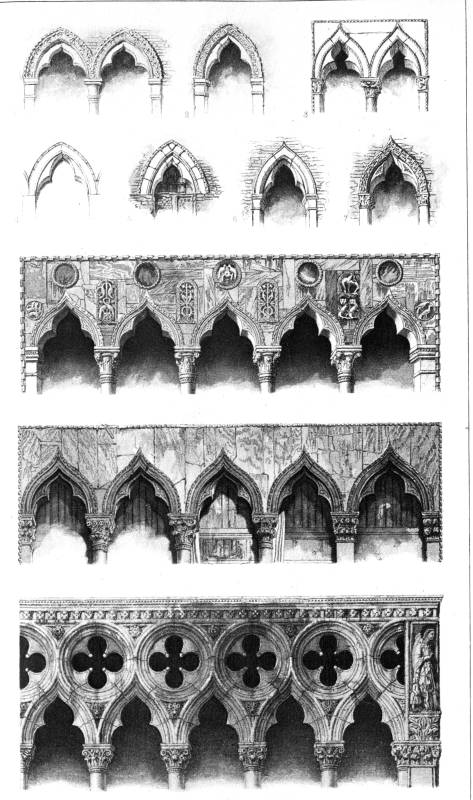
Two things create a city, its people and its architecture.  For Ruskin, these were one and the same.  His love of gothic architecture is well documented in, amongst others, The Stones of Venice, a multi volume work from the 1850s (at nearly half a million words).  One of the many remarkable things about Ruskin was that he didn't love Venetian gothic architecture for itself, but what he saw in it and around it, temporally as well as spatially. Like Carlyle, Mill, and Dickens, he was wary of the Victorian love of the mechanical.  Manual labourers were reduced to 'hands' that could work in the factory.  Elizabeth Gaskell's women labourers express the point well.  In North and South they proclaim that they have no intention of going into domestic service to be someone else's skivvy.  Why would they? When they can sell their labour freely on the open market, in whichever town they choose to live. They are the masters of their own domain: their bodies.  The tragedy of this scene is that Gaskell's implied reader is well aware that these working women have exchanged one kind of servitude for another more terrible one.  
In the increasingly industrialised world, Ruskin saw that the worker was being turned into a 'tool', to be beaten and used, blunted, and eventually discarded.  He explains, in the Stones, 'You must either make a tool of the creature, or a man of him. You cannot make both. Men were not intended to work with the accuracy of tools, to be precise and perfect in all their actions.' By freeing the worker from his enslavement to the machine, society will yield, with all its imperfections, a productive cell, but more importantly, a contented one.  
In his previous work, The Seven Lamps of Architecture, in thinking about the rudely ornate aspects of gothic architecture, he had wondered 'Was the carver happy while he was about it?'  Medieval 'hand-work' was rustic, rugged, imperfect, unfinished; a signatory expression of the worker's identity, albeit expressed within a specified form. Victorian factory work created, with reliable rapidity, perfectly finished objects, where the mindless machine-operator was merely a  faceless conduit towards the means of profit. 
The signature had become a stamp. 
The other aspect to Ruskin's obsession with Venice was as a vibrant corrective to Victorian apathy and assumed supremacy.  It was a place and a people, both of fading glory.  A few years before Ruskin was born, Ludivico Manin, the last Doge of Venice had been forced to step down by Napoleon.  The Venetian republic, a thousand years flourishing, was over, and now the city was in decay, too. Like the great Victorian historians, Macaulay and Carlyle, Ruskin found a parallel for his own times in the past.  He  hurriedly sketched details from columns, orders, arches, in fear that they would fade and crumble to sand, just as he believed England would. He could already see it happening in the months and years between his frequent visits.  Such is the charm of Venice.  Its architecture lends itself to melancholy and to death.  But it's people smile.  In the Campos the children, play, run and scream with a joyful abandon that you don't see in the deserted streets of London.  For them, the fading buildings are a backdrop to something always beginning.
The boat ride to the Lido takes about half an hour.  I have no map, but I can hardly get lost on an island the shape of a needle.  One side faces Venice, the other, the Adriatic.  I a expecting to have to dodge crowds, just like my journey to the Accademia, but instead I am greeted by the overwhelming scent of yellow-flowering pansies. this is a roundabout.  Why?  The island is a couple of hundred metres wide and only a mile or two long, but there are a surprising number of cars, here.
Left? 
Right? 
Straight. The beach must be on the opposite side.  After the last few days if navigating a city by the sun, I catch myself spotting landmarks so I can find my way back.  After a few hundred yards I have left the bustle of shops behind.  I see the beach, and  a runner stretching, but no one else. I smile at him, but I'm a pane of glass. 'Ah, like London runners.'. The pathway is smooth, so for the first time in many months, the shoes come off.  I've been so preoccupied with marathon training that I haven't barefoot run since maybe October. It's bliss.  As soon as I take my shoes off I remember why I love running so much.  The pain of the marathon is long forgotten as my feet whisper along the walkway.  
Onto the sand.  I negotiate my way nearer the shore where the sand is firmer.  There is the soft crunch as shards of shell are ground finer, each step only accelerating the work of time and these flecks' journey to powder.  There is no one on the beach.  The sun is full in the sky.  I must be on the wrong part of the island.  I clamber over groynes making my way slowly along the coast.  I become convinced that life is elsewhere, that there is something else to see, so after a mile I make my way up the beach, to the road, and to the other side of the island.  Is this where everyone is hiding.  But no, as suspected it is the coast facing the Venice mainland.  
This is the yacht described in the text.
Taken while skinning the Lido.
A yacht whispers into view.  It has a few people sunbathing, still as corpses. The air, heavy with a glimmering silence.  Never have I seen the sea so undisturbed, made stranger somehow with the backdrop of Venice in the distance.  I turn to make my way back to the Vaporetto.  I have an idea of how I can continue this run.
I am sort of lost, but I know I'm headed in the right direction - I can see Venice, after all. I feel a sudden urge to record this quietness, made emptier somehow by my bare feet smooching the concrete.  I wrestle my phone from my pocket and turn on the video - but it only records slaps, scene-jerks and funny breathing.  After a mile or so of weaving between beachfront, roads and inlets, I am woken.  
My olfactory sense has been so attenuated by years of medication and London that I am surprised to find it penetrated once again by the same sweet floral scent.  I follow my nose left. I quickly snap the flowerbed and run for the Vaporetto which is ready to leave.  The first stop is St Elena, on the eastern extremity of the island.  On my way in I had spied a path that looked like it ran all the way from here to San Marco, the scene of the daily siege of Venice by the tourist hoard. Seen from the bell tower of San Giorgio across the Guidecca canal they look like ants attacking a corpse.
The Vaporetto pulls away and I am like a dog in the traps wanting to continue my run.  The ride back is quick.  The barrier is lifted and I'm out of the boat.  I turn and shout to the crowd of passengers, "I'm going to race you all to San Marco".  Being English, of course, I did no such thing.  But I did want to race it. As soon as I began to run, at a much faster pace, I was immediately reminded of the time when I was eight-or-so, when on the street I used to see my mother in the passenger seat of our car in her role as driving instructor.  The learners always drove cautiously on our empty streets and I would puff out my chest, straighten my hands to darts like the T-1000, and sprint in an all out race-to-the-death, leaping over unattended bikes, tightroping garden walls, until either I lost, or the car turned off route. It was later explained to me that this wasn't quite the thing that the learner driver should have to contend with.
In the first leg of the race I take a clear lead.  The Vaporetto has to load passengers, and is slow to shake of its inertia.  But then, I am suddenly taken off route via an inlet over a bridge, losing at least forty metres.  The Vaporetto has made good ground and is now out in front, but not by much.  Then another inlet, but this time with no diversion.  I reach the summit and see the boat pulling in at Giardini.  I keep a good pace and the boat is slow to start again.  My legs still don't remember their marathon last week.  We are away.  Another bridge to climb towards Arsenale and each one gets thicker and thicker with tourists whose attention waivers in all directions but this runner's. Another bridge and my legs feel the climb of this one, but there is a long flat ahead.  I let go pushing hard in the sunlight.  As the Vaporetto pulls into the stop I pass it again and head towards San Marco.  My legs have had enough of this game.  Like the crowds, they feel sluggish and inattentive.  I pass a thick-haired golden retriever looking very unhappy at being out on a lead in such weather. But I don't make it to San Marco.  In the crowd, I lose sight of the boat and it is difficult to maintain walking pace.  I come to a stop outside the the hotel where Henry James had finished The Portrait of a Lady  in 1880 (that he wrote about in the 1907 Preface).  The challenge is over. I wipe the grains of salt and sweat from my face and feel a burning thirst.  I remember that I haven't drunk anything for hours.  I turn around and retrace my steps to a quieter point at which to catch the boat back. A couple holding hands smile at me, only then do I realise that it is because I too am smiling.
The desire to play is easily forgotten in someone my age, and I'm glad to be reminded of it.  Creativity is not an ability, but merely a desire to romp and caper with ideas or the body. Sartre was so enamoured of play that he ascribed to it all-but the meaning of life.  In Being and Nothingness, he argues that our condition is such that we spend our lives cowering in the face of our freedom.  We engage in complex acts of deception to deny our biological inheritance of freedom. We structure entire lives and livelihoods around our self-deception. For Sartre, play was a way to touch that void once again.  
The desire to play is central to our happiness. And today, even trapped by the ant-hive crowds of Venice (of which I am one), I still find that moments of liberty are to be found in the creativity of the body.  The stonemason may have to carve a gargoyle, but it is one of their own design.  Even in the narrowest and most crowded of alleyways, squeezing between pot-bellied walls that look like they are waiting to belch, expression is still deliverance and release. 


From Ruskin's Stones of Venice

The 'ant-hive' crowds of Venice.